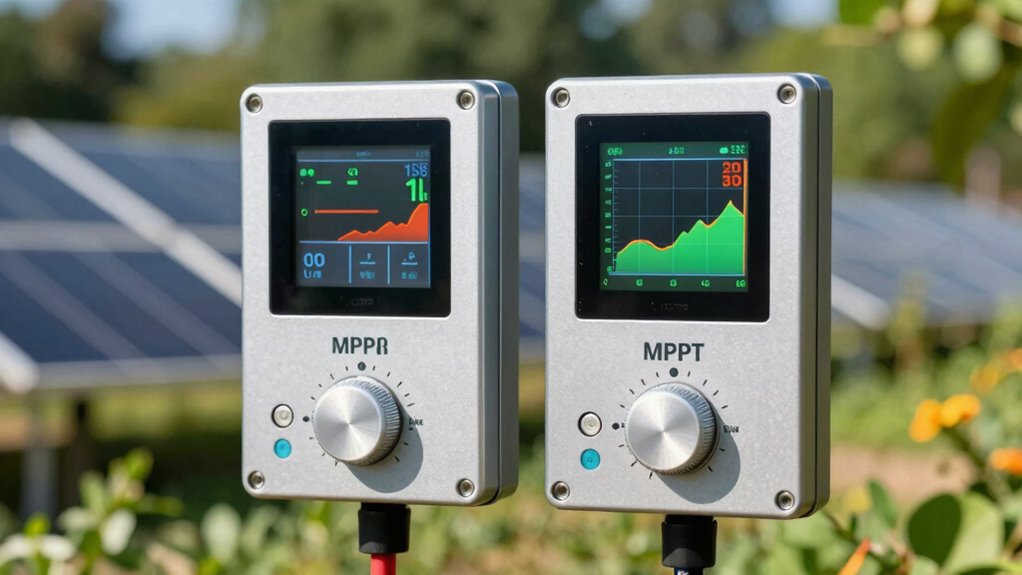

If you’re choosing between MPPT and PWM controllers, understand that MPPT units optimize your solar energy by constantly adjusting to the maximum power point. They capture more energy, charge batteries faster, and perform well in variable weather conditions, making them ideal for larger or expanding systems. PWM controllers are cheaper and simpler but less efficient, especially during changing sunlight. To discover which one offers the best long-term performance, keep going to learn more.
Key Takeaways
- MPPT controllers maximize energy capture, especially in variable weather, leading to higher efficiency than PWM controllers.
- They are more cost-effective over time by reducing the need for additional panels and improving system performance.
- MPPT controllers better suit larger or expanding solar setups, optimizing battery charging and reducing energy waste.
- They provide consistent performance regardless of sunlight fluctuations, unlike PWM controllers that are less efficient in variable conditions.
- Investing in MPPT controllers enhances long-term system reliability, energy savings, and return on investment.
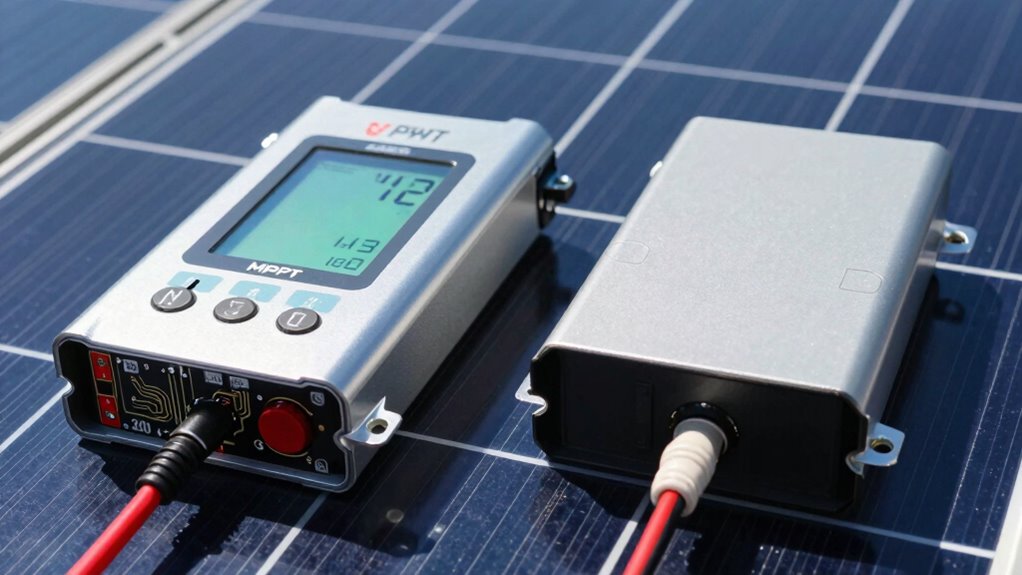
When choosing a solar charge controller, understanding the differences between MPPT and PWM technology is essential. This decision can considerably impact your system’s overall efficiency and long-term costs. MPPT (Maximum Power Point Tracking) controllers are designed to optimize energy harvest by constantly adjusting their input to match the maximum power point of your solar panels. This means they can extract more energy from your panels, especially during variable weather conditions or when panels operate at higher voltages. As a result, your battery efficiency improves because more power flows into your batteries with less waste. This increased efficiency can lead to faster battery charging and better utilization of your solar investment. While MPPT controllers tend to have a higher upfront price, they often justify the cost through increased energy capture, especially in larger or more complex systems. Additionally, MPPT controllers are more effective in variable weather conditions, ensuring consistent performance regardless of sunlight fluctuations.
On the other hand, PWM (Pulse Width Modulation) controllers are simpler and less expensive. They work by gradually reducing the power going into the batteries as they reach full charge, which prevents overcharging. While this method is effective for smaller systems or those with less sunlight variability, it doesn’t optimize energy transfer. Consequently, your system may not produce as much power, reducing overall battery efficiency. Furthermore, since PWM controllers operate at lower voltages and don’t maximize energy extraction, you might find yourself needing larger or additional panels to meet your energy needs. This can increase your installation costs over time, as more panels and wiring are required to compensate for the lower efficiency.
Choosing between MPPT and PWM isn’t just about initial costs; it’s about long-term performance and savings. If you have a larger system or plan to expand your setup, investing in an MPPT controller makes sense because it maximizes battery efficiency and minimizes wasted energy. This efficiency can lead to fewer panels needed, ultimately reducing installation costs over the system’s lifespan. Conversely, if you’re working with a small, budget-conscious setup and limited space, a PWM controller might suffice, but keep in mind it won’t deliver the same level of performance or scalability.
Frequently Asked Questions
How Do MPPT and PWM Controllers Impact Overall Solar System Lifespan?
MPPT controllers generally extend your solar system’s lifespan by optimizing battery health and reducing stress on your inverter. They adapt to changing sunlight conditions, preventing overcharging and overheating, which can damage batteries. PWM controllers are simpler but may cause more wear over time, affecting overall system longevity. Choosing an MPPT controller guarantees better inverter compatibility and keeps your system running smoothly longer.
Are There Specific Climates Where One Controller Type Outperforms the Other?
Ever wondered if climate influences your controller choice? In colder, less sunny climates, MPPT controllers outperform PWM by maximizing solar efficiency and adapting better to temperature fluctuations. Conversely, in hot, consistently sunny environments, PWM controllers can be be sufficient and more cost-effective. So, understanding your local climate helps you select the right controller, ensuring peak performance and longevity for your solar system. Wouldn’t you want the most effective setup for your specific conditions?
Can MPPT Controllers Be Used With Battery Banks of Different Voltages?
Yes, MPPT controllers can be used with battery banks of different voltages, but you need to verify battery compatibility and proper voltage matching. They are versatile and adapt to varying battery voltages, optimizing power transfer. However, always confirm your system’s voltage ratings and compatibility to prevent issues. Proper voltage matching helps you get the most out of your MPPT controller, maximizing efficiency and prolonging your battery bank’s lifespan.
What Are the Maintenance Differences Between MPPT and PWM Controllers?
Imagine your solar setup as a well-oiled machine—maintenance routines keep it humming smoothly. MPPT controllers usually demand less frequent upkeep because their advanced components are built for durability, handling temperature swings better. PWM controllers, with simpler parts, might need more regular checks to prevent corrosion and wear. Overall, MPPTs tend to be more durable, reducing maintenance efforts, while PWM controllers may require more attention to keep your system running efficiently.
How Do Installation Complexities Compare for MPPT Versus PWM Systems?
You’ll find that installing an MPPT controller is more wiring complex and takes longer compared to a PWM system. MPPT units require precise wiring, multiple connections, and proper configuration, which can extend installation time. In contrast, PWM controllers have simpler wiring processes, making them quicker and easier to set up. If you’re comfortable with more intricate wiring, MPPT offers better performance, but for straightforward installs, PWM is more convenient.
Conclusion
When choosing between MPPT and PWM controllers, remember that power potential prevails. MPPT maximizes your solar’s might with smarter, sleeker solutions, while PWM simply plugs away. If you want a worthwhile upgrade that truly makes a difference, go for the gain and grab an MPPT controller. Prioritize performance, pump up productivity, and power your projects with the best. Make the smart switch — step up your solar game with MPPT today!