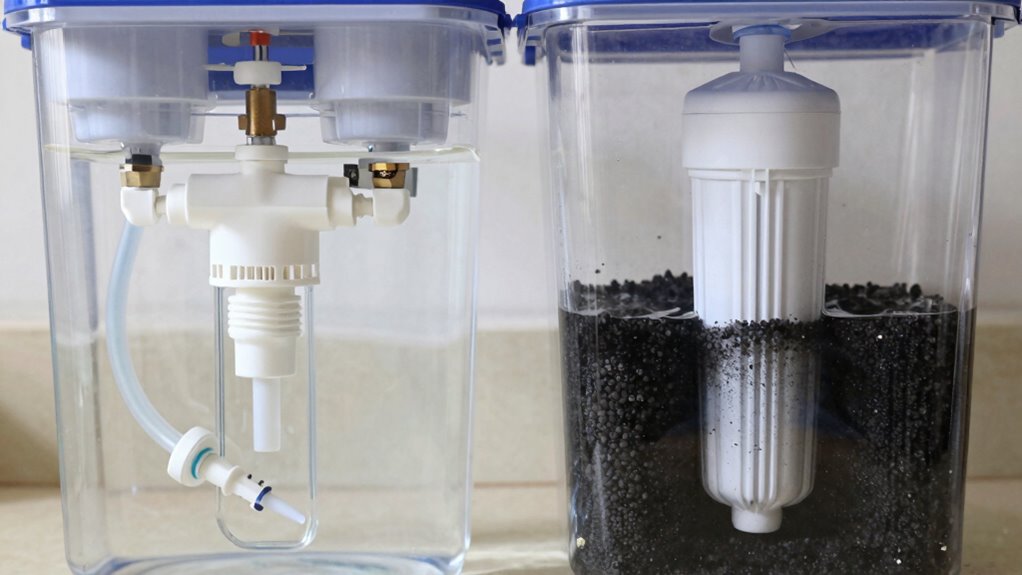

If you want thorough removal of heavy metals, bacteria, and dissolved solids, a reverse osmosis system is your best choice. It filters contaminants extensively but may strip away beneficial minerals and affect the water’s taste and pH. On the other hand, carbon filters are simpler, cost-effective, and excel at improving flavor by removing chlorine and chemicals while preserving minerals. To decide which suits your needs better, explore how each system balances contaminant removal, mineral content, and taste.
Key Takeaways
- Reverse osmosis offers comprehensive removal of heavy metals, bacteria, and dissolved solids, ideal for water safety concerns.
- Carbon filters effectively improve taste and odor by adsorbing chlorine and VOCs, enhancing drinking water flavor.
- RO systems can strip beneficial minerals and lower pH, often requiring additional mineral or pH balancing stages.
- Carbon filters are simpler, cheaper, and easier to maintain, suitable for basic chemical and taste improvements.
- Choose RO for thorough contaminant removal and water safety, or carbon filters for taste and chemical filtering based on needs and budget.
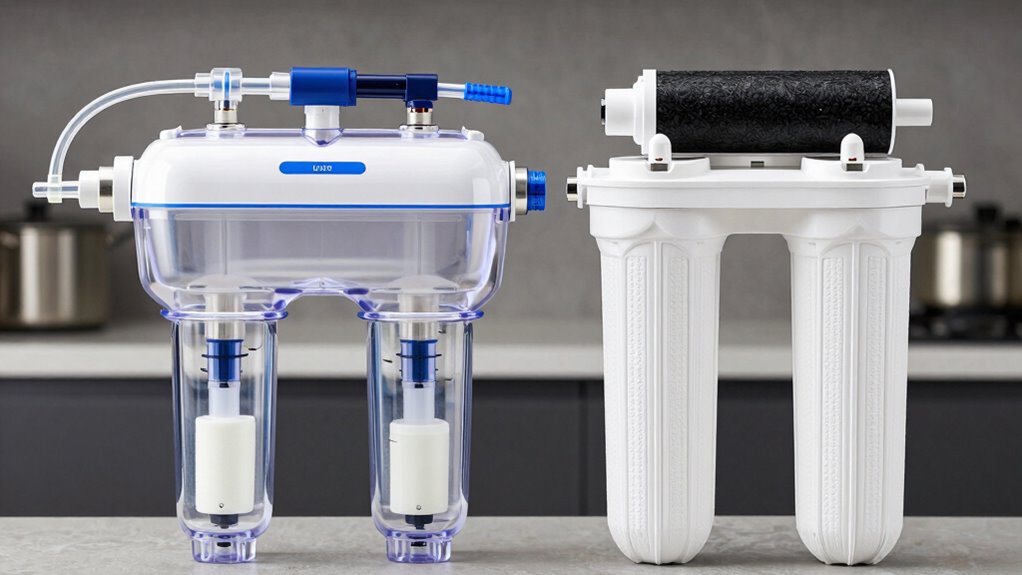
Choosing the right water filter can considerably improve the quality of your drinking water, but with so many options available, it’s easy to feel overwhelmed. When deciding between reverse osmosis and carbon filters, understanding their differences is key. Reverse osmosis systems are highly effective at removing contaminants, including heavy metals, bacteria, and dissolved solids. They work by forcing water through a semi-permeable membrane, which filters out impurities. However, this process can also strip away beneficial minerals and alter the water’s pH balance, often making it more acidic. To counteract this, many systems incorporate mineral retention features or post-filtration pH balancing stages, ensuring your water remains not only clean but also properly mineralized and balanced in pH. This is important because mineral retention preserves essential trace elements like calcium and magnesium, which support your health and contribute to better taste.
On the other hand, carbon filters excel at improving water’s taste and odor by adsorbing chlorine, volatile organic compounds (VOCs), and other chemicals. They are simple, cost-effective, and require minimal maintenance. While they don’t remove dissolved solids or heavy metals as effectively as reverse osmosis, they do retain beneficial minerals, helping maintain the water’s natural mineral content. This retention ensures your water isn’t overly depleted of essential elements, which can happen with more aggressive filtration methods. Carbon filters also tend to preserve the natural pH of your water better, avoiding the acidity that sometimes results from reverse osmosis. If your goal is to improve taste and remove common chemicals without stripping away essential minerals, a high-quality carbon filter may be the best choice. Additionally, incorporating a pH balancing stage can help maintain optimal water acidity and alkalinity levels, supporting overall health and taste.
Ultimately, your decision hinges on your specific needs. If you’re concerned about thorough contaminant removal and don’t mind a more complex system that might require mineral readdition or pH adjustment, reverse osmosis is a solid option. But if you prioritize preserving your water’s natural minerals and flavor, a carbon filter offers a straightforward, effective solution. Consider factors like water source, budget, maintenance, and health priorities. Whichever you choose, look for systems that include features like pH balancing and mineral retention, ensuring your water remains safe, tasty, and nutritionally balanced. Making an informed choice means your drinking water will support your health and satisfy your taste buds every time.
Frequently Asked Questions
How Long Do Reverse Osmosis Systems Typically Last?
Your reverse osmosis system typically lasts around 10 to 15 years with proper maintenance. The system lifespan depends on regular filter and membrane replacements, usually every 6 to 12 months for pre-filters and 2 to 3 years for the membrane. Staying on top of these replacement frequencies guarantees peak performance and prolongs your system’s life, saving you money and ensuring clean, safe drinking water.
Are Carbon Filters Effective Against Viruses?
Did you know that carbon filters can remove over 99% of common contaminants? However, their virus filtration effectiveness is limited. While they excel at filtering chemicals and pollutants, they aren’t reliable for eliminating viruses. If virus protection is your priority, consider systems specifically designed for virus removal, like UV or reverse osmosis. Carbon filters alone don’t provide all-encompassing virus filtration, so choose your system based on your specific water safety needs.
What Is the Maintenance Cost for Each System?
You’ll find that maintenance costs vary depending on the filter lifespan and replacement frequency. Carbon filters typically need replacement every 3 to 6 months, costing around $15 to $50 per filter, making them budget-friendly. Reverse osmosis systems have more expensive filters that last 6 to 24 months, costing $50 to $200 each. Regular maintenance guarantees peak performance, but overall, carbon filters usually have lower ongoing costs.
Can These Filters Remove Specific Contaminants Like Lead?
Yes, both reverse osmosis and carbon filters can remove lead and heavy metals from your water. Reverse osmosis systems are particularly effective at eliminating lead due to their fine filtration membranes, while carbon filters also reduce lead and other heavy metals by adsorbing them onto their activated carbon. For ideal lead removal, consider installing a system specifically designed for heavy metal filtration, and regularly maintain it to guarantee continued effectiveness.
Which System Is More Environmentally Friendly?
Think of your water system as a green garden needing care. Reverse osmosis often wastes more water, like a leaky faucet, making it less eco-friendly. Carbon filters, with their sustainability comparison, sip water conservatively and use fewer resources, making them more environmentally friendly. If you seek eco-friendly features, choose the carbon filter, which nurtures your health and the planet with gentle, mindful filtration.
Conclusion
Choosing between reverse osmosis and carbon filters depends on your needs. If you want pure, mineral-free water, RO systems are your best bet. But if you prefer water with retained minerals and improved taste, carbon filters do the job. Think of it this way: like a fine-tuned camera capturing every detail, RO offers precision, while a carbon filter provides the warmth and flavor of a well-loved cup. Both serve your needs—just choose what matters most to you.