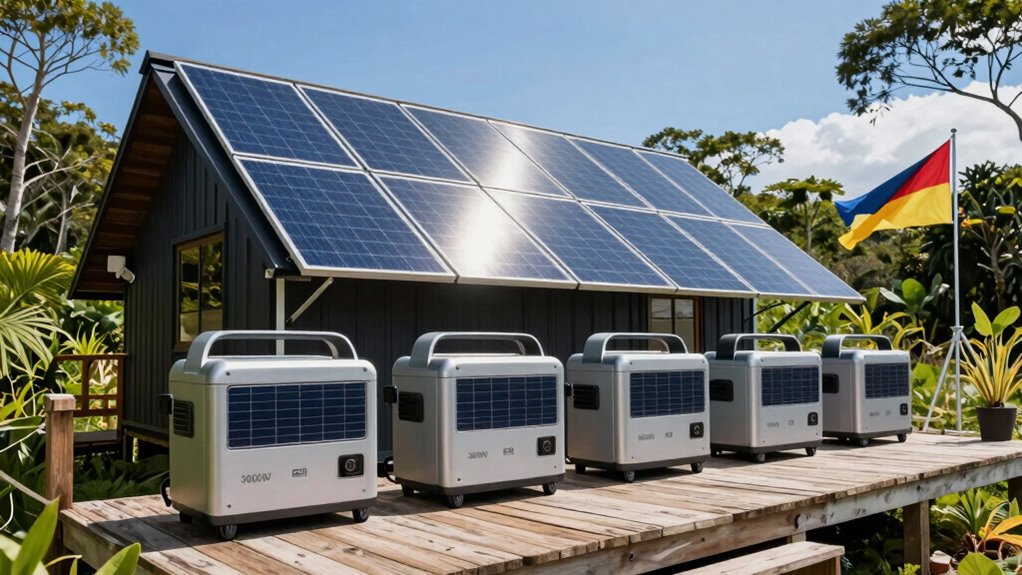

For an off-grid cabin, the best 3000W solar generator depends on whether you need a portable power station or a more permanent solar system. I rank the SUNGOLDPOWER 3000W kit with a 5.12kWh battery and 800W of panels as the strongest fit for cabin use because it pairs an inverter with substantial storage and included solar input. The Anker SOLIX F3000 is a compelling portable alternative, while the 1440W off-grid kit offers a larger battery-and-panel setup for buyers planning a fixed installation. The main tradeoffs are battery capacity, daily solar production, portability, and the extra wiring and setup required by kits. Read on for the full comparison and guidance on matching a system to your cabin loads.

Get travel and outdoor gear delivered free — and shop member deals
- Fast, free delivery on millions of items
- Access to Prime Big Deal Days deals on October 6–7
- Prime Video, Amazon Music and more included
Complete the kit


Key Takeaways
- Cabin-ready kits differ from portable stations: The SUNGOLDPOWER 3000W kit with 5.12kWh storage and 800W of panels, plus the 1440W kit with a 5.12kWh battery, offer a more installation-oriented starting point than the 3,072Wh portable power stations.
- 3000W output does not mean long runtime: The portable units with 3,072Wh batteries share similar stated storage, so the appliances you run and the hours you run them matter more than the inverter rating alone.
- Included panels change the buying equation: The Jackery HomePower 3000 and HomePower 3600 Plus bundles include two 200W panels, while the Anker SOLIX F3000 and Dabbsson 3000L list solar panels as optional or separate.
- Some listings need closer specification checks: The generic kit advertises 3000W peak output, and the AUECOOR kit emphasizes daily production and storage; neither headline alone confirms continuous output or how well the system will suit cabin-scale loads.
- Choose around installation and expansion needs: Portable power stations favor simpler, movable backup, while the 24V SUNGOLDPOWER and other off-grid kits call for more planning around wiring, panels, battery capacity, and system compatibility.
| AIMS Homestead Bristlecone 460W Solar Kit with 3000W Inverter |  | Best Complete Cabin Kit | Solar panel output: 460W (2 × 230W flexible panels) | Inverter output: 3000W pure sine wave | Charge controller: 60A | VIEW ON AMAZON | See Our Full Breakdown |
| Anker SOLIX F3000 Portable Power Station, 3,072Wh |  | Best for Expandable Cabin Backup | Battery capacity: 3,072Wh | Battery chemistry: LiFePO4 | Output wattage: 3,600W | VIEW ON AMAZON | See Our Full Breakdown |
| Jackery HomePower 3000 Portable Power Station with Two 200W Solar Panels |  | Best for Fast Backup Switching | Battery capacity: 3,072Wh | AC output: 3,600W | Surge output: 7,200W | VIEW ON AMAZON | See Our Full Breakdown |
| Solar Panel and Inverter Kit with Charge Controller, USB Ports, and 3000W Peak Output |  | Best for Small DC and Device Loads | Solar panel power: 18W ±5% | Solar panel type: Monocrystalline | Inverter peak output: 3000W | VIEW ON AMAZON | See Our Full Breakdown |
| Pecron F3000LFP Portable Power Station, 3072Wh |  | Best for Port Variety and Cabin Workspaces | Battery capacity: 3,072Wh | Battery chemistry: LiFePO4 | Output power: 3,600W pure sine wave | VIEW ON AMAZON | See Our Full Breakdown |
| Gendome Home3000 Portable Power Station, 3072Wh LiFePO₄ Battery, 3000W Output |  | Best Portable Power Station for Cabin Flexibility | Battery capacity: 3072Wh | Battery chemistry: LiFePO₄ | AC output: 3000W | VIEW ON AMAZON | See Our Full Breakdown |
| 1440W Off-Grid Solar Power Kit with 3kW Inverter and 5.12kWh LiFePO4 Battery |  | Best Included Solar Capacity | Solar panel output: 1440W (12 × 120W) | Battery capacity: 5.12kWh | Battery configuration: 4 × 12.8V, 100Ah batteries | VIEW ON AMAZON | See Our Full Breakdown |
| SUNGOLDPOWER 3000W Off-Grid Solar Kit with 5.12kWh LiFePO4 Battery and 800W Solar Panels |  | Best for Expandable Solar Plans | Inverter output: 3000W | System voltage: 24V DC | Battery capacity: 5.12kWh | VIEW ON AMAZON | See Our Full Breakdown |
| SUNGOLDPOWER 3000W 24V Off-Grid Solar Kit with Inverter, Panels, and LiFePO4 Batteries |  | Best for Utility-Backed Cabin Backup | Inverter power: 3000W | System voltage: 24V | Inverter output: 120Vac | VIEW ON AMAZON | See Our Full Breakdown |
| AUECOOR 480W Solar Panel Kit with 1.92kWh Daily Output and 2.56kWh Battery Storage |  | Best for Light-Load Cabins | Maximum panel power: 480W | Panel configuration: 4 × 120W monocrystalline panels | Panel conversion efficiency: 22.7% | VIEW ON AMAZON | See Our Full Breakdown |
| Dabbsson Portable Power Station 3000L, 3072Wh, 3000W AC Output, 3600W Power Boost, Fast Charge, Solar Generator for Home Backup, Camping & RVs (Solar Panel Optional) |  | Best for High-Draw Appliances | Capacity: 3072Wh | Continuous AC output: 3000W | Power Boost output: 3600W | VIEW ON AMAZON | See Our Full Breakdown |
| Jackery HomePower 3600 Plus Portable Power Station with 2 200W Solar Panels |  | Best Expandable Cabin Bundle | Battery capacity: 3584Wh | AC output: 3600W | Parallel output: 7200W | VIEW ON AMAZON | See Our Full Breakdown |
| solar generator 3000w for off grid cabin | Battery capacity | Weight |
|---|---|---|
| AIMS Homestead Bristlecone 460 | — | — |
| Anker SOLIX F3000 Portable Pow | 3,072Wh | 91.5 lbs |
| Jackery HomePower 3000 Portabl | 3,072Wh | 59.5 lbs |
| Solar Panel and Inverter Kit w | — | — |
| Pecron F3000LFP Portable Power | 3,072Wh | 63.3 lbs |
| Gendome Home3000 Portable Powe | 3072Wh | 84.9 pounds |
| 1440W Off-Grid Solar Power Kit | 5.12kWh | — |
| SUNGOLDPOWER 3000W Off-Grid So | 5.12kWh | — |
| SUNGOLDPOWER 3000W 24V Off-Gri | — | — |
| AUECOOR 480W Solar Panel Kit w | — | — |
| Dabbsson Portable Power Statio | — | 59.5 lb |
| Jackery HomePower 3600 Plus Po | 3584Wh | 77.2 lb |
More Details on Our Top Picks
AIMS Homestead Bristlecone 460W Solar Kit with 3000W Inverter
For a cabin buyer starting without an existing power system, the AIMS Homestead Bristlecone is the most installation-oriented pick here: it bundles flexible panels, a 3000W pure sine wave inverter, a charge controller, an AGM battery, wiring, and fuses. That package reduces the need to assemble core components separately, while the flexible panels may suit surfaces that cannot take rigid modules. Its main limitation is the mismatch between a 3000W inverter and only 2.5kWh of battery storage with 460W of panel capacity. It can run suitable loads, but sustained high-power appliances will drain the battery quickly and solar replenishment will be modest. Compared with the Anker SOLIX F3000, this is a more complete fixed-kit starting point, but the Anker offers a larger, expandable battery system. I would skip AIMS for cabins with heavy daily loads.
Pros:- Bundles the core power components, wiring, and fuses for a more complete system start
- 3000W pure sine wave inverter supports compatible household appliances and electronics
- Flexible 230W panels can suit some curved or uneven mounting surfaces
- Expandable system can accommodate changing power needs
Cons:- The 2.5kWh AGM battery offers limited runtime for sustained cabin loads
- 460W of solar capacity may replenish the battery slowly during demanding use
- The array needs about 30 sq ft of installation area
Best for: Cabin owners who want a bundled off-grid starter system with an inverter, battery, controller, wiring, and flexible panels.
Not ideal for: Cabin owners running high-draw appliances for long periods or needing substantial overnight storage; the included battery is 2.5kWh and solar capacity is 460W.
- Solar panel output:460W (2 × 230W flexible panels)
- Inverter output:3000W pure sine wave
- Charge controller:60A
- Battery:200Ah AGM, 2.5kWh
- Solar panel dimensions:32 × 1 × 62 in
- Required installation area:Approximately 30 sq ft
- Included cables:25 ft PV extender wires; 6 ft battery and inverter cables
Our verdict“Choose AIMS if you want a bundled cabin kit and can keep daily loads moderate, but look to a larger-storage system for heavier use.”
Anker SOLIX F3000 Portable Power Station, 3,072Wh
The Anker SOLIX F3000 suits cabin owners who want portable power now and room to build out storage later. Its 3,600W output exceeds the 3000W target, while solar input up to 2,400W gives it more potential for rapid replenishment than the Jackery HomePower 3000’s included pair of 200W panels. Capacity can expand to 24kWh, a meaningful advantage for longer stays when paired with additional batteries. The tradeoff is that the base unit holds 3,072Wh, so expansion is the path to longer off-grid runtime, not something the base capacity provides by itself. At 91.5 pounds, it is also the heaviest portable option in this group. Its 120V output means cabins needing 240V appliances must pair two stations, adding complexity. I’d favor this over the Pecron when maximum expansion headroom matters more than portability.
Pros:- 3,600W output provides headroom above the 3000W target
- Expandable capacity reaches up to 24kWh with additional batteries
- Solar input up to 2,400W supports substantial solar charging potential
- Accepts both solar and generator charging
Cons:- At 91.5 pounds, it is cumbersome to move regularly
- A single unit supplies 120V; 240V output requires pairing two stations
- Base capacity is 3,072Wh, so extended cabin runtime depends on added batteries and load
Best for: Cabin owners planning to add compatible batteries over time and wanting high solar-input capacity for a growing backup system.
Not ideal for: Buyers who need a light, easy-to-carry unit or direct 240V output from a single station.
- Battery capacity:3,072Wh
- Battery chemistry:LiFePO4
- Output wattage:3,600W
- Solar input:Up to 2,400W
- Expandable capacity:Up to 24kWh
- Voltage:120V
- Power outlets:11
- Weight:91.5 lbs
- Warranty:5 years
Our verdict“Pick the Anker if you want a portable station with unusually broad expansion headroom and can manage its weight and 120V-only single-unit output.”
Jackery HomePower 3000 Portable Power Station with Two 200W Solar Panels
The Jackery HomePower 3000 earns its place for cabins where brief outages or interruptions matter as much as off-grid power: its UPS switchover is 20ms or less, and its 3,600W AC output gives it useful headroom for compatible loads. The included two 200W panels make this a more ready-to-charge bundle than the Anker SOLIX F3000, which is sold as a power station without panels in the supplied details. But 400W of included solar is modest for a cabin drawing power every day; the stated solar recharge to 80% takes nine hours with those panels. Its 3,072Wh battery is also a finite reserve, so heavy overnight use can quickly eat into stored energy. At 59.5 pounds, it is lighter than the Anker, though still a substantial unit to move. I’d choose it for backup continuity, not maximum solar harvest.
Pros:- UPS switchover of 20ms or less supports quick backup handoff
- 3,600W AC output and 7,200W surge rating provide load-starting headroom
- Includes two 200W solar panels and supports multiple charging methods
- LiFePO4 battery is rated for 4,000 cycles to 70% capacity
Cons:- The included 400W of solar takes about nine hours to recharge the unit to 80%
- The power station and panels may arrive in separate packages
- At 59.5 pounds, moving it around a cabin or vehicle takes effort
Best for: Cabin owners who want a portable battery system with quick UPS switching and a starter pair of solar panels for essential loads.
Not ideal for: Full-time off-grid users expecting the included panels to rapidly replenish the battery under substantial daily demand.
- Battery capacity:3,072Wh
- AC output:3,600W
- Surge output:7,200W
- Battery type:LiFePO4
- Battery cycle life:4,000 cycles to 70% capacity
- UPS switchover:20ms or less
- Solar panels:Two 200W panels
- Weight:59.5 lbs
- Voltage:120V
Our verdict“Choose the Jackery for backup switching and a bundled solar start, but plan for more panel capacity if it will serve as daily cabin power.”
Solar Panel and Inverter Kit with Charge Controller, USB Ports, and 3000W Peak Output
Despite its 3000W peak label, this kit is not a 3000W cabin generator: its inverter is rated for only 300W continuous power, and the included panel produces just 18W. That distinction puts it far below the Jackery HomePower 3000 or Pecron F3000LFP for appliances, pumps, or multiple cabin circuits. Its useful niche is much smaller—basic device charging or light vehicle and camping use when paired with a suitable battery. The modified sine wave output also narrows compatibility compared with the pure sine wave systems from AIMS and Pecron, particularly for sensitive electronics or equipment with motors. The low component weight may appeal to a portable setup, but the listed details do not include a battery, so buyers must supply one. I would not select this as a primary off-grid cabin power system.
Pros:- Includes a monocrystalline panel, inverter, and charge controller
- Two USB ports and AC outlets support different small-device connections
- Built-in protections cover overload, short circuit, overheating, and voltage issues
- Lightweight panel can suit portable camping or vehicle setups
Cons:- Inverter continuous rated power is 300W, not 3000W
- The included 18W panel contributes very little energy for cabin use
- Modified sine wave output may not suit sensitive electronics or some appliances
Best for: Campers or cabin owners seeking a small supplemental setup for modest loads and who already have a compatible battery.
Not ideal for: Anyone seeking a true 3000W continuous cabin system or planning to run appliances, pumps, or sensitive electronics.
- Solar panel power:18W ±5%
- Solar panel type:Monocrystalline
- Inverter peak output:3000W
- Inverter input voltage:DC 10.5–15V
- Inverter output voltage:AC 220V or 110V
- Output waveform:Modified sine wave
- Charge controller:30A; 12V/24V automatic conversion
- USB ports:2
Our verdict“Treat this as a small supplemental charging kit, not a 3000W solar generator for running an off-grid cabin.”
Pecron F3000LFP Portable Power Station, 3072Wh
The Pecron F3000LFP is a strong fit for a cabin workspace or shared room where several devices need power at once: its 13 ports include six AC outlets, two USB-C ports, USB-A, a carport, and DC outputs. The 3,600W pure sine wave output and 3,072Wh LiFePO4 battery put it in the same broad class as the Anker SOLIX F3000 and Jackery HomePower 3000, while its 63.3-pound weight is easier to manage than Anker’s 91.5 pounds. Expansion reaches 10,752Wh, but adding the specified battery requires a separately sold XT120-M cascade cable, so system growth involves another component. Its 1,600W solar input is below Anker’s 2,400W ceiling, which may limit charging speed with a large array. I’d choose Pecron for connection flexibility, not for the greatest expansion or solar-input capacity.
Pros:- 3,600W pure sine wave output and 3,072Wh LiFePO4 storage suit a range of cabin loads
- 13 ports provide varied connections for AC, USB, car, and DC devices
- Supports AC, solar, and car charging with app monitoring
- UPS switchover is specified at 8–20ms
Cons:- Solar input tops out at 1,600W, below the Anker SOLIX F3000’s 2,400W maximum
- The XT120-M cascade cable is sold separately for the specified expansion battery
- At 63.3 pounds, it is portable but not light to carry
Best for: Cabin owners powering a mix of AC appliances, USB devices, and DC equipment who want many connections and the option to expand storage.
Not ideal for: Buyers who want the highest solar-input capacity in this lineup or expect battery expansion to work without purchasing an additional cable.
- Battery capacity:3,072Wh
- Battery chemistry:LiFePO4
- Output power:3,600W pure sine wave
- AC charging input:1,800W max
- Solar input:1,600W max, 25–120V
- Ports:13 total: 6 AC, 2 USB-C, 2 USB-A, 1 carport, 2 DC 5525
- UPS switchover:8–20ms
- Weight:63.3 lbs
- Expandable capacity:Up to 10,752Wh; XT120-M cascade cable sold separately
Our verdict“Choose the Pecron if port variety and a lighter carry than the Anker matter more than maximum solar input or simple expansion.”
Gendome Home3000 Portable Power Station, 3072Wh LiFePO₄ Battery, 3000W Output
The Gendome Home3000 suits cabin owners who want a ready-to-use battery unit rather than a fixed solar installation. Its 3,072Wh LiFePO₄ battery and 3,000W AC output can support a mix of cabin appliances, while 17 ports make it easier to charge devices without adding a separate hub. Unlike the 1440W Off-Grid Solar Power Kit, it arrives as a portable power station and supports wall, solar, and wind charging; however, the product data does not include panels, so solar generation requires a separate purchase. App monitoring and a stated wall-charge rate of up to 80% in 50 minutes add flexibility when an outlet or generator is available. The tradeoff is its 84.9-pound weight: I would treat it as movable backup, not a unit to carry regularly between remote sites. Its cycle-life claim is also to 60% remaining capacity, not full retention.
Pros:- 3,072Wh LiFePO₄ capacity paired with 3,000W AC output
- 17 output ports, including two 140W USB-C ports and two wireless charging pads
- Supports wall, solar, and wind charging
- App provides remote control and usage monitoring
Cons:- At 84.9 pounds, it is cumbersome to move frequently
- Solar panels are not listed as included, so solar charging needs additional equipment
- The stated 6,500-plus cycle life ends at 60% of original capacity
Best for: Cabin owners who want a portable, app-monitored power station for backup and device charging, and plan to source solar or other charging equipment separately.
Not ideal for: Buyers seeking a complete solar kit in one purchase or a lightweight station that is easy to carry over rough cabin access routes.
- Battery capacity:3072Wh
- Battery chemistry:LiFePO₄
- AC output:3000W
- USB-C output:140W
- Output ports:17
- Charging methods:Wall outlet, solar, wind
- Wall charge time:Up to 80% in 50 minutes with an 1800W wall outlet
- Weight:84.9 pounds
- Battery cycle life:Over 6,500 cycles to 60% capacity
Our verdict“Choose the Home3000 if you want a portable, high-capacity cabin backup station and are comfortable sourcing its solar panels separately.”
1440W Off-Grid Solar Power Kit with 3kW Inverter and 5.12kWh LiFePO4 Battery
For a cabin where daily solar replenishment matters more than portability, this kit makes a stronger starting point than the Gendome Home3000: it includes a 1,440W panel array, a 5.12kWh LiFePO₄ battery bank, a 60A MPPT controller, and a 3,000W pure sine wave inverter. That larger battery reserve gives more stored energy than the Gendome’s 3,072Wh, while the included panels can begin producing power without a separate panel purchase. The inverter’s 6,000W peak output may accommodate brief startup surges, and pure sine wave output is suited to electronics and motor-driven loads. The key compromise is setup: this is a collection of components to wire into a system, not a plug-in station. I would also verify the cable and accessory details before installation, since the listing does not specify the full set. Actual harvest still depends on sunlight and placement.
Pros:- Includes 1,440W of panels, 5.12kWh of battery storage, inverter, controller, combiner box, and cables
- 3,000W continuous inverter output with 6,000W peak output
- LiFePO₄ battery bank includes a battery management system
- MPPT controller offers an LCD display and app control
Cons:- Wiring and installation may require electrical knowledge
- Solar generation varies with weather, season, and panel placement
- The exact cable and accessory details for the complete kit are not specified
Best for: Cabin owners setting up a fixed or semi-permanent system who want included panels and more stored battery capacity than a portable power station provides.
Not ideal for: Buyers who need a plug-and-play unit, lack confidence with electrical installation, or need predictable solar production through cloudy periods.
- Solar panel output:1440W (12 × 120W)
- Battery capacity:5.12kWh
- Battery configuration:4 × 12.8V, 100Ah batteries
- Battery type:LiFePO₄
- Inverter output:3000W continuous, 6000W peak
- Inverter voltage:24V DC to 120V AC
- Charge controller:60A MPPT
- PV combiner box:4-to-1 with DC surge protection
Our verdict“Pick this kit over the Gendome Home3000 if you want a more complete, higher-capacity solar setup and can handle the installation work.”
SUNGOLDPOWER 3000W Off-Grid Solar Kit with 5.12kWh LiFePO4 Battery and 800W Solar Panels
The SUNGOLDPOWER kit pairs a 5.12kWh battery bank with a 3,000W inverter, but its included solar array is only 800W. That makes it a reasonable fit for a cabin with moderate loads or a plan to add panels later, rather than the strongest ready-now solar choice beside the 1440W Off-Grid Solar Power Kit. The listing states roughly 3,200Wh of daily generation with four hours of full sunlight; that figure is conditional, not a guaranteed daily supply. Its 4,000W maximum PV array capacity leaves headroom for expansion, though adding panels means checking the system’s limits and installation requirements. Two 24V LiFePO₄ batteries, Bluetooth monitoring, and stated self-heating add practical details for cabin use. I would compare this carefully with the SUNGOLDPOWER 3000W 24V Off-Grid Solar Kit: that listing specifies an 80A MPPT controller and 10ms backup transfer, while this one clearly calls out its 800W array and expansion ceiling.
Pros:- 5.12kWh of LiFePO₄ storage paired with a 3,000W inverter
- Includes four 200W monocrystalline panels, mounting brackets, cables, and breakers
- Maximum PV array capacity is listed as 4,000W
- Battery monitoring is available over Bluetooth, and the batteries include self-heating
Cons:- The included 800W panel array is smaller than the 1,440W array in the 1440W Off-Grid Solar Power Kit
- The stated daily generation assumes four hours of full sunlight
- Taking advantage of the higher PV limit requires additional panels and suitable system design
Best for: Cabin owners who want a 5.12kWh battery and 3,000W inverter now, with room to increase solar capacity later.
Not ideal for: Buyers who need a larger included panel array for faster recharging or who cannot add panels and manage system expansion.
- Inverter output:3000W
- System voltage:24V DC
- Battery capacity:5.12kWh
- Battery configuration:Two 24V 100Ah LiFePO₄ batteries
- Solar panel capacity:800W (four 200W panels)
- Maximum daily energy output:Approximately 3200Wh with 4 hours of full sunlight
- Maximum PV array:4000W, 400V
- Maximum battery charger:80A
- Battery cycle life:4000+ deep cycles
Our verdict“Choose this kit if battery capacity and future panel expansion matter more to you than having the largest included array.”
SUNGOLDPOWER 3000W 24V Off-Grid Solar Kit with Inverter, Panels, and LiFePO4 Batteries
This SUNGOLDPOWER kit is the more backup-focused choice beside the brand’s 800W-panel kit. It combines a 3,000W inverter charger, an 80A MPPT controller, four 200W panels, and two 24V 100Ah LiFePO₄ batteries. Its standout cabin detail is the stated 10ms transfer time when utility or generator power drops, which can help supported loads ride through a source change; it is not a substitute for checking appliance compatibility or wiring the system correctly. The kit can charge from solar or AC, giving it a practical fallback when weather limits panel output. Compared with the 1440W Off-Grid Solar Power Kit, its 800W of included panels provide less solar capacity, but the specified AC charging and transfer behavior make its backup role clearer. The 120V–400Vdc MPPT input range calls for careful array planning, and installation is not as straightforward as plugging in a portable station.
Pros:- Combines a 3,000W inverter charger, MPPT controller, panels, and LiFePO₄ batteries
- Supports both solar charging and 40A AC battery charging
- Manufacturer states a 10ms backup transfer time
- Includes four 200W monocrystalline panels and two 24V 100Ah batteries
Cons:- The 800W panel array is smaller than the 1,440W array in the 1440W Off-Grid Solar Power Kit
- The MPPT input range of 120V–400Vdc requires careful panel-string design
- A wired kit demands more installation planning than a portable power station
Best for: Cabin owners with utility or generator access who want solar charging plus a specified fast backup transfer for compatible loads.
Not ideal for: Buyers seeking a simple portable power station, a larger included solar array, or a system they can install without checking voltage and wiring requirements.
- Inverter power:3000W
- System voltage:24V
- Inverter output:120Vac
- MPPT solar charging:80A
- AC battery charging:40A
- MPPT voltage range:120V–400Vdc
- Solar panels:4 × 200W monocrystalline
- Batteries:2 × 24V 100Ah LiFePO₄
- Backup transfer time:10ms
Our verdict“Choose this kit if your cabin has utility or generator backup and you value its specified transfer time more than a larger included panel array.”
AUECOOR 480W Solar Panel Kit with 1.92kWh Daily Output and 2.56kWh Battery Storage
The AUECOOR kit has a 3,000W pure sine wave inverter, but its 480W panel array and 2.56kWh battery point to light cabin use rather than sustained high-demand living. The inverter can support compatible appliances up to its stated output, yet the smaller storage and solar supply limit how long those loads can run and how quickly the battery can be replenished. Compared with the SUNGOLDPOWER 800W-panel kit, AUECOOR includes less solar capacity and half the listed battery storage, so it is a weaker match for cabins relying on daily solar for several appliances. Its appeal is a bundled set of four panels, two LiFePO₄ batteries, a controller, cables, and mounting brackets for smaller setups such as a shed or part-time cabin. The claimed 1.92kWh daily output assumes four hours of sunlight, and the description also gives an inconsistent “1.92WH” figure that buyers should clarify.
Pros:- Includes four panels, batteries, inverter, controller, cables, and mounting brackets
- 3,000W pure sine wave inverter with 6,000W peak output
- LiFePO₄ batteries include a built-in battery management system
- Panel conversion efficiency is listed as 22.7%
Cons:- 480W of panels and 2.56kWh of storage are limited beside the SUNGOLDPOWER 800W-panel kit
- Daily output depends on sunlight and is stated under a four-hour full-sun assumption
- The description gives inconsistent daily-output units, listing both 1.92kWh and 1.92WH
Best for: Owners of small cabins or sheds with modest daily energy needs who want a bundled 3,000W inverter and basic solar components.
Not ideal for: Full-time off-grid cabin households running multiple substantial loads or anyone expecting the 3,000W inverter rating to mean high energy capacity.
- Maximum panel power:480W
- Panel configuration:4 × 120W monocrystalline panels
- Panel conversion efficiency:22.7%
- Battery configuration:2 × 12.8V 100Ah LiFePO₄ batteries
- Battery storage:2.56kWh
- Charge controller:40A MPPT
- Inverter:3000W pure sine wave, 6000W peak
- Daily output:Up to 1.92kWh under four hours of sunlight
- Included accessories:Y branch connector, cables, and four Z-brackets
Our verdict“Choose AUECOOR for a small, light-load cabin or shed, but look to a larger-panel kit for regular household-level off-grid use.”
Dabbsson Portable Power Station 3000L, 3072Wh, 3000W AC Output, 3600W Power Boost, Fast Charge, Solar Generator for Home Backup, Camping & RVs (Solar Panel Optional)
The Dabbsson 3000L suits cabin owners who need 3000W continuous output and occasional extra headroom: its Power Boost reaches 3600W, while 6000W starting wattage can help with brief motor surges. Its 3072Wh capacity is substantial for lights, communications, and intermittent appliance use, but the listed full-load runtime is only about an hour, so it is not a substitute for a larger battery bank during sustained heavy demand. Compared with the Jackery HomePower 3600 Plus, it holds less energy and lacks included solar panels, but it is lighter at 59.5 pounds and still offers AC, car, and compatible solar charging. The tradeoff for cabin use is that solar panels are optional and its weight makes frequent carrying awkward. I’d favor it when output capability matters more than a ready-to-use solar bundle.
Pros:- 3072Wh capacity supports a range of cabin essentials
- 3000W continuous output with 3600W Power Boost and 6000W starting wattage
- Can recharge from an AC outlet, car charger, or compatible solar panels
- Mobile app supports real-time monitoring and control
Cons:- About one hour of runtime at full load limits sustained heavy-appliance use
- At 59.5 pounds, it is cumbersome to carry regularly
- Solar panels are sold separately
Best for: Cabin owners who need to run high-wattage appliances briefly and can source compatible solar panels separately
Not ideal for: Buyers seeking long runtimes for heavy loads or an all-in-one solar bundle, since full-load runtime is listed at about one hour and panels are optional
- Capacity:3072Wh
- Continuous AC output:3000W
- Power Boost output:3600W
- Starting wattage:6000W
- Solar input range:12–60V
- AC outlets:6
- Weight:59.5 lb
- Warranty:5 years (3 years standard plus 2-year extension)
Our verdict“Choose the Dabbsson 3000L for strong appliance output in a self-contained station, provided you have a separate plan for solar charging and extended runtimes.”
Jackery HomePower 3600 Plus Portable Power Station with 2 200W Solar Panels
For a cabin owner who wants a higher-capacity starting point and solar panels in the same purchase, the Jackery HomePower 3600 Plus pairs a 3584Wh battery with 3600W AC output and two 200W panels. Its four charging methods and two-hour hybrid AC-plus-DC charging can help when solar conditions are poor and another power source is available. The expandable capacity is its main distinction from the Dabbsson 3000L: Jackery can scale to 21kWh per unit, or 43kWh with multiple units, while the Dabbsson is lighter and easier to carry. This is still a 77.2-pound station, though wheels and a telescopic handle ease movement across level ground. Its included panels may ship separately, and a two-hour hybrid recharge depends on access to both AC and DC input, not solar alone.
Pros:- 3584Wh capacity with expansion up to 21kWh per unit
- 3600W AC output and 240V operation when units are used in parallel
- Includes two 200W solar panels and supports four charging methods
- Wheels and telescopic handle make it easier to roll than the heavier-to-handle Dabbsson 3000L
Cons:- At 77.2 pounds, lifting it remains difficult despite the wheels
- The power station and solar panels may arrive in separate packages
- Two-hour hybrid charging requires AC and DC power sources; solar charging is listed at four hours
Best for: Cabin owners who want included starter solar panels, expandable storage, and the option to move the station on wheels
Not ideal for: People who must lift a power station into a vehicle or remote cabin regularly, or who expect the included 400W of panels alone to meet every energy need
- Battery capacity:3584Wh
- AC output:3600W
- Parallel output:7200W
- Expandable capacity:Up to 21kWh per unit or 43kWh with multiple units
- Battery type:LFP
- Hybrid AC+DC charging time:2 hours
- Included solar panels:2 × 200W
- Weight:77.2 lb
- Warranty:5 years
Our verdict“Pick the Jackery HomePower 3600 Plus if you want an expandable cabin system with starter panels and can accommodate its substantial weight.”

How We Picked
I judged these options by how well their stated specifications answer the needs of an off-grid cabin: continuous inverter output, usable battery capacity, included solar charging, and the likely effort involved in setting up and maintaining the system. I also looked at whether a listing is a portable power station, a bundled panel package, or a more permanent off-grid kit, since those categories solve different problems even when their inverter ratings are similar. A 3000W headline was not enough on its own; battery storage and panel input affect how long a cabin can run appliances and how readily the battery can recharge.
The ranking favors options that combine cabin-relevant storage and solar input with a clear path to practical use, then distinguishes portable convenience from installation-focused capability. Bundles with panels have an advantage for buyers starting without solar equipment, while units with panels sold separately may suit owners who already have an array. I treat unclear or limited listing details as a reason for buyers to verify continuous output, charging limits, compatibility, and included components before purchase. The products are not interchangeable: the best pick depends on whether the priority is fixed off-grid power, portable backup, or a lower-complexity entry point.
Factors to Consider When Choosing Solar Generator 3000w For Off Grid Cabins
Before choosing a 3000W system, I would start with the cabin’s daily energy use and installation plan rather than the inverter label. These factors can reveal when a portable station will do the job and when a larger battery-and-panel setup is a better match.
Match Inverter Output to Real Appliance Loads
List the appliances you expect to run at the same time, then add their running wattage to estimate the inverter load. Motors in pumps, refrigerators, and some tools can draw a short startup surge above their normal operating demand. Check both continuous output and surge rating; a product described as 3000W peak may not provide 3000W continuously. Avoid choosing a system based only on the largest appliance in the cabin if several will run together. If the combined load regularly nears the inverter limit, select a higher-capacity setup or schedule appliances so they do not start at once. This check prevents a nominally powerful unit from becoming the weak link in everyday use.
Size Battery Storage for Overnight and Cloudy Periods
Inverter wattage tells you how much power a system can supply at once, while battery capacity affects how long it can supply it. Estimate daily energy use in watt-hours by multiplying each appliance’s watts by its hours of operation, then add a margin for inverter losses and changing conditions. A 3,072Wh battery can be a reasonable portable reserve, but it may not cover heavy heating, cooking, or long periods of refrigeration without frequent charging. Cabin owners who need more autonomy should compare larger battery configurations and expansion options rather than assume a high output rating means long runtime. Also check whether the listed capacity is nominal and whether the maker specifies usable capacity. A few days of poor weather can change the storage needs more than a brief surge in appliance demand.
Calculate Solar Input Against Seasonal Conditions
Panel wattage is a rated figure, not a promise of daily energy production. Sun angle, shade, roof direction, season, and weather all affect how much energy reaches the battery. Compare a kit’s panel capacity and maximum solar charging input with your daily use, then allow for cloudy days and shorter winter daylight. A small included panel bundle may be convenient but can recharge slowly after a substantial draw. Buyers with existing panels should verify connector type, voltage range, and charge-controller limits before mixing equipment. For a cabin with trees or limited roof space, prioritize flexible panel placement and realistic charging expectations over a headline panel number.
Choose Portable Power or a Fixed Off-Grid System
Portable power stations are attractive when you want a self-contained unit that can move between a cabin, vehicle, or backup location. A fixed off-grid kit can better suit regular cabin use, but it generally asks more of the owner: panel placement, wiring, component compatibility, and safe installation all need attention. Decide whether you want an integrated system or are comfortable selecting and connecting separate components. Check what the package actually includes, since some listings bundle panels and batteries while others may require additional equipment. For permanent wiring or high-current battery connections, consult a qualified installer and follow local electrical requirements. The convenience of a portable unit can outweigh expandability if the cabin’s loads are modest and seasonal.
Check Chemistry, Expansion, and Long-Term Service
Battery chemistry affects weight, expected cycle life, charging behavior, and how a system handles routine use. Several products here specify LiFePO₄ batteries, but buyers should still check the maker’s cycle-life conditions, temperature limits, warranty terms, and service support. Ask whether additional batteries can be added and whether expansion requires matching models or a specific connection method. A cabin in a cold climate needs a plan for charging and storing batteries within their stated temperature range. Replacement availability matters when a system will be far from a service center. Paying more for a supported, expandable system may make sense for year-round use, while occasional visits can favor a simpler portable setup.
Read the Fine Print on Ratings and Included Equipment
Product titles often highlight peak watts, total battery capacity, or panel output without giving equal attention to continuous AC power and charging limits. Before buying, confirm the inverter’s continuous rating, surge duration, AC outlet count, solar input range, and recharge time under stated conditions. Check whether cables, charge controllers, mounting hardware, and panels are included, since a kit may need more parts before it can supply power. A daily-output claim depends on sunlight and location, so treat it as a planning reference rather than a guaranteed yield. Compare warranty coverage and support channels as part of the ownership cost, especially for systems installed at a remote cabin. Clear specifications are more useful than a familiar brand name when you need to match equipment to a particular load.
Frequently Asked Questions
Is a 3,072Wh portable power station enough for an off-grid cabin?
It can cover modest loads, but capacity alone cannot answer that without knowing your daily energy use. Add up watt-hours for lighting, refrigeration, charging, and other appliances, then account for conversion losses and the time between solar recharges. A 3,072Wh unit may suit weekend use or serve as a backup, while full-time cabins with cooking, heating, pumps, or long cloudy stretches may need more storage. Compare it with the larger 5.12kWh batteries in the off-grid kits listed here. If you rely on a portable unit, plan which appliances can be switched off when the battery is low.
Should I buy a portable power station or a complete off-grid solar kit?
Choose a portable station when ease of setup, mobility, and simple backup matter more than a permanent installation. A kit with an inverter, battery, and panels may be a stronger starting point for a cabin used regularly, especially when the package has more storage and solar capacity. Kits can require more work to mount panels, connect components, and meet electrical safety requirements. Check whether the kit includes every part you need, rather than assuming the word “kit” means installation-ready. If you are unsure about wiring or system design, get qualified help before connecting a fixed system.
Do the solar panels included with a generator provide enough power for cabin use?
Included panels can be a useful starting point, but their rated wattage does not tell you how much energy they will deliver each day at your cabin. Shading, season, panel angle, and local weather affect production, and cabin loads vary widely. The Jackery bundles in this roundup include two 200W panels, while the SUNGOLDPOWER kit listed here includes 800W of panels; those differences matter for recharge potential but do not guarantee a particular daily yield. Compare panel capacity with your estimated consumption and the unit’s maximum solar input. If production is short, you may need more compatible panels or a smaller daily load.
Can a 3000W solar generator run a well pump or refrigerator?
Possibly, but confirm both the appliance’s running watts and its startup surge against the generator’s continuous and surge ratings. A pump or refrigerator may draw several times its normal power briefly when its motor starts, and starting it while other loads are running adds to the demand. The product title’s 3000W figure may describe peak output rather than continuous output, so read the specification sheet carefully. Battery capacity then determines how long the appliance can run between recharges. For a pump that is central to cabin use, check its actual nameplate or measured load before choosing a system.
Which option makes more sense if my cabin is used only on some weekends?
A portable station can make sense for intermittent visits because it is easier to store, move, and use without building a permanent solar installation. A bundled-panel model may simplify charging if you do not already own compatible panels, while a unit with panels sold separately can suit buyers who have an existing array. For a fixed cabin that needs power through several cloudy days, the larger-battery off-grid kits may offer a more suitable foundation. Consider how the battery will be stored between visits and follow its temperature and charge-storage guidance. The right choice depends on whether convenience or longer-duration, installed power matters more during your stays.
Conclusion
For a cabin that needs a more complete off-grid setup, I would start with the SUNGOLDPOWER 3000W kit with 5.12kWh of storage and 800W of panels as my best overall pick in this lineup. The 1440W off-grid kit with a 5.12kWh battery is a strong alternative for buyers who value its larger panel setup, while the Anker SOLIX F3000 is better suited to buyers who want portable power rather than a fixed system. For best value, compare the Pecron F3000LFP and Gendome Home3000 against your load list and included accessories, since their stated 3,072Wh capacities put them in a similar portable-power category. Beginners who want a bundled starting point can look at the Jackery HomePower 3000 with two 200W panels, while buyers seeking a larger bundled portable system can consider the Jackery HomePower 3600 Plus. If your needs center on a permanent cabin installation, favor the off-grid kits; if you need flexible backup, favor a portable station and verify that its continuous output, battery storage, and solar input match your actual loads.
Fall Picks
fall essentials
As an affiliate, we earn on qualifying purchases.