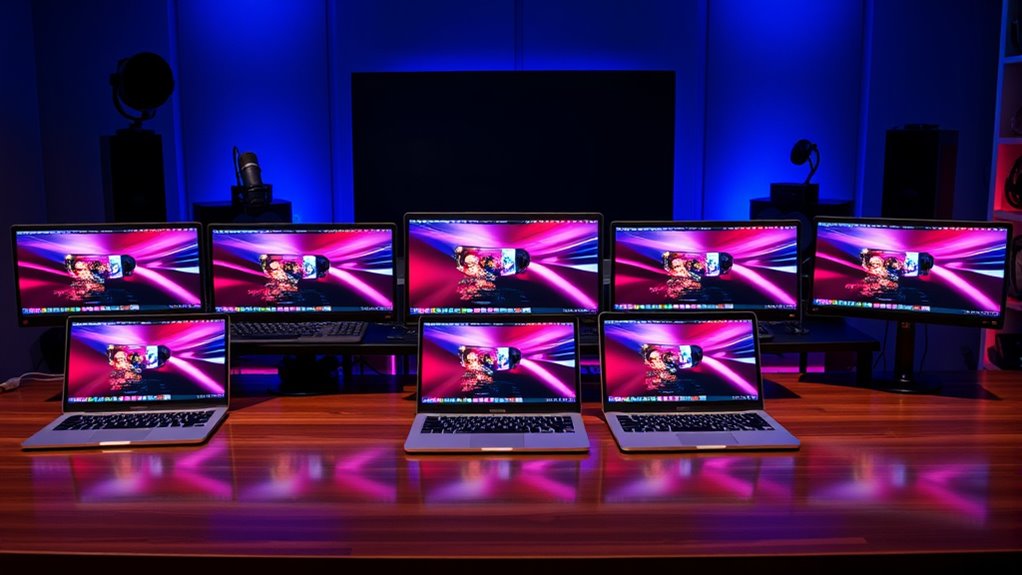

For live streaming and content creation, I’d choose the 16-inch MacBook Pro with M5 Pro, 48GB memory, and 2TB SSD as the best overall balance of screen space, working memory, and project storage. The 14-inch M5 Pro with 48GB memory is a strong fit if portability matters more, while an M5 Max with 128GB memory suits demanding multi-app workflows and large creative projects. The main tradeoffs are portability versus workspace, M5 Pro versus M5 Max graphics capacity, and how much memory and internal storage to buy upfront. More power can help with heavier production, but it does not replace good lighting, audio equipment, or a reliable internet connection. Read on for the full breakdown and help matching a configuration to your workflow.

Get travel and outdoor gear delivered free with Prime
- Fast, free delivery on millions of items
- Prime Video, Amazon Music and more included
- Member-only deals all year
Complete the kit



Key Takeaways
- The 16-inch M5 Pro with 48GB memory and 2TB SSD is the most balanced configuration here for creators who want more workspace and storage without stepping up to an M5 Max.
- The 14-inch M5 Pro with 48GB memory and 1TB SSD favors mobility, but its smaller display and lower storage capacity ask more of an external-monitor and drive setup.
- M5 Max configurations with 128GB memory are aimed at heavy multitasking and demanding creative workloads; they are difficult to justify for straightforward single-camera streaming.
- Memory and storage vary more than the chip name alone suggests: the lineup includes M5 Max systems with 64GB or 128GB memory and SSDs from 2TB to 4TB.
- The 14-inch M5 model with 32GB memory offers a less powerful entry point into this group, while the 24GB M5 Pro is a more limited choice for intensive multitasking.
| Apple MacBook Pro 14.2-inch with M5 Pro, 48GB Memory, 1TB SSD, Space Black |  | Best Compact Studio Workstation | Chip: Apple M5 Pro | CPU / GPU: 15-core CPU / 16-core GPU | Display: 14.2-inch Liquid Retina XDR, 3456 × 2234, up to 120Hz | VIEW ON AMAZON | See Our Full Breakdown |
| Apple MacBook Pro 16.2-inch with M5 Pro, 18-core CPU, 20-core GPU, 48GB Memory, 2TB SSD, Space Black |  | Best Overall for Live Streaming and Creation | Chip: Apple M5 Pro | CPU / GPU: 18-core CPU / 20-core GPU | Display: 16.2-inch Liquid Retina XDR | VIEW ON AMAZON | See Our Full Breakdown |
| Apple MacBook Pro 16.2-inch with M5 Max, 18-Core CPU, 40-Core GPU, 64GB Memory, 2TB SSD, Nano-Texture Glass, Space Black |  | Best for Bright or Glare-Prone Studios | Chip: Apple M5 Max | CPU / GPU: 18-core CPU / 40-core GPU | Display: 16.2-inch Liquid Retina XDR with nano-texture glass | VIEW ON AMAZON | See Our Full Breakdown |
| Apple 16.2-inch MacBook Pro with M5 Pro, 18-Core CPU, 20-Core GPU, 24GB Memory, and 1TB SSD |  | Best Entry Point to a Large-Screen Pro Setup | Chip: Apple M5 Pro | CPU / GPU: 18-core CPU / 20-core GPU | Display: 16.2-inch Liquid Retina XDR | VIEW ON AMAZON | See Our Full Breakdown |
| Apple MacBook Pro 16.2-inch Laptop with M5 Max, 18-Core CPU, 40-Core GPU, 128GB Memory, 4TB SSD, Space Black | | Best for Maximum On-Laptop Capacity | Chip: Apple M5 Max | CPU / GPU: 18-core CPU / 40-core GPU | Display: 16.2-inch Liquid Retina XDR | VIEW ON AMAZON | See Our Full Breakdown |
| Apple 16-inch MacBook Pro with M5 Max, 18-core CPU, 40-core GPU, 128GB Memory, 2TB SSD, Space Black |  | Best for Memory-Heavy Production | Model: 16-inch MacBook Pro (2026) | Chip: Apple M5 Max | CPU / GPU: 18-core CPU / 40-core GPU | VIEW ON AMAZON | See Our Full Breakdown |
| Apple MacBook Pro 14.2-inch with M5 Chip, 32GB Memory, 1TB SSD, Silver |  | Best for Portable Streaming Setups | Chip: Apple M5, 10-core CPU and 10-core GPU | Display: 14.2-inch Liquid Retina XDR | Memory: 32GB unified memory | VIEW ON AMAZON | See Our Full Breakdown |
| Apple MacBook Pro 16-inch with M5 Max, 18-Core CPU, 40-Core GPU, 128GB Memory, 2TB SSD, Space Black | | Best for Multi-Display Studio Work | Processor: Apple M5 Max, 18-core CPU | Graphics: 40-core GPU | Display: 16.2-inch Liquid Retina XDR | VIEW ON AMAZON | See Our Full Breakdown |
| Apple 16-inch MacBook Pro with M5 Max, 18-core CPU, 40-core GPU, 128GB Memory, 4TB SSD, Space Black |  | Best for Large Local Media Libraries | Chip: Apple M5 Max | CPU / GPU: 18-core CPU / 40-core GPU | Unified memory: 128GB | VIEW ON AMAZON | See Our Full Breakdown |
| Apple MacBook Pro 14.2-inch with M5 Max, 18-Core CPU, 40-Core GPU, 64GB Memory, 2TB SSD, Silver |  | Best Compact High-Power Pick | Processor: Apple M5 Max, 18-core CPU | Graphics: 40-core GPU | Display: 14.2-inch Liquid Retina XDR | VIEW ON AMAZON | See Our Full Breakdown |
| macbook pro for live streaming and content creation | Display | Storage | Memory | Chip |
|---|---|---|---|---|
| Apple MacBook Pro 14.2-inch wi | 14.2-inch Liquid Retina XDR, 3456 × 2234, up to 120Hz | 1TB SSD | 48GB unified memory | Apple M5 Pro |
| Apple MacBook Pro 16.2-inch wi | 16.2-inch Liquid Retina XDR | 2TB SSD | 48GB unified memory | Apple M5 Pro |
| Apple MacBook Pro 16.2-inch wi | 16.2-inch Liquid Retina XDR with nano-texture glass | 2TB SSD | 64GB unified memory | Apple M5 Max |
| Apple 16.2-inch MacBook Pro wi | 16.2-inch Liquid Retina XDR | 1TB SSD | 24GB unified memory | Apple M5 Pro |
| Apple MacBook Pro 16.2-inch La | 16.2-inch Liquid Retina XDR | 4TB SSD | 128GB unified memory | Apple M5 Max |
| Apple 16-inch MacBook Pro with | 16.2-inch Liquid Retina XDR | 2TB SSD | 128GB | Apple M5 Max |
| Apple MacBook Pro 14.2-inch wi | 14.2-inch Liquid Retina XDR | 1TB SSD | 32GB unified memory | Apple M5, 10-core CPU and 10-core GPU |
| Apple MacBook Pro 16-inch with | 16.2-inch Liquid Retina XDR | 2TB SSD | 128GB unified memory | — |
| Apple 16-inch MacBook Pro with | 16.2-inch Liquid Retina XDR | 4TB SSD | — | Apple M5 Max |
| Apple MacBook Pro 14.2-inch wi | 14.2-inch Liquid Retina XDR | 2TB SSD | 64GB unified memory | — |
More Details on Our Top Picks
Apple MacBook Pro 14.2-inch with M5 Pro, 48GB Memory, 1TB SSD, Space Black
For creators who stream away from a fixed desk, this 14.2-inch MacBook Pro pairs 48GB of unified memory with a 1TB SSD, giving editing and streaming apps room to run together without the larger footprint of the 16-inch models. Its Thunderbolt 5, HDMI, and SDXC ports can simplify a camera-and-monitor setup by reducing adapter needs, while the 12MP Center Stage camera is useful for direct-to-camera sessions. Compared with the 16.2-inch M5 Pro with 48GB memory and 2TB SSD, this configuration is easier to carry but offers less screen and storage space. The supplied listing also conflicts on display size and chip specifications, so I would verify the exact configuration before buying. It suits mobile creators more than those building a large editing workstation.
Pros:- 48GB unified memory supports running streaming, editing, and browser apps together.
- Thunderbolt 5, HDMI, and SDXC provide useful connections for cameras, displays, and media cards.
- 12MP Center Stage camera supports direct-to-camera calls and streams.
- 120Hz Liquid Retina XDR display offers a sharp, smooth preview surface.
Cons:- Product information conflicts about the display size and chip specifications, making the exact configuration uncertain.
- The 1TB SSD provides less room for large video projects than the 2TB options in this roundup.
- The 14.2-inch screen is more constrained for editing timelines than the 16.2-inch models.
Best for: Mobile streamers and video editors who want 48GB of memory, built-in production ports, and a more portable MacBook Pro.
Not ideal for: Creators who need a verified configuration, a larger timeline workspace, or 2TB or more of internal storage.
- Chip:Apple M5 Pro
- CPU / GPU:15-core CPU / 16-core GPU
- Display:14.2-inch Liquid Retina XDR, 3456 × 2234, up to 120Hz
- Memory:48GB unified memory
- Storage:1TB SSD
- Camera:12MP Center Stage
- Ports:Three Thunderbolt 5, MagSafe 3, SDXC card slot, HDMI, headphone jack
- Wireless:Wi-Fi 7, Bluetooth 6
Our verdict“Choose this compact pick for mobile production only after confirming the listed chip and display configuration.”
Apple MacBook Pro 16.2-inch with M5 Pro, 18-core CPU, 20-core GPU, 48GB Memory, 2TB SSD, Space Black
This configuration is the most balanced fit for creators who need one machine for live production, editing, and everyday work. The 18-core CPU, 20-core GPU, and 48GB of unified memory provide more headroom for simultaneous streaming and creative apps than the 24GB M5 Pro model, while the 2TB SSD leaves more room for recordings and active projects than the 1TB options. Its 16.2-inch Liquid Retina XDR display gives timelines and preview windows more breathing room, and the HDMI, SDXC, and Thunderbolt 5 ports suit a desk-based setup. Compared with the M5 Max models, it is a less specialized choice for GPU-heavy effects or extensive external-display workflows, but that extra power may not help every streamer. Its larger body is also less convenient to carry.
Pros:- 18-core CPU and 20-core GPU suit demanding editing and streaming workflows.
- 48GB unified memory gives multitasking apps more room than the 24GB M5 Pro configuration.
- 2TB SSD offers more space for source footage and active projects than 1TB alternatives.
- HDMI, SDXC, and three Thunderbolt 5 ports support a flexible production desk.
Cons:- The 16.2-inch chassis is less convenient for frequent travel than the 14.2-inch model.
- M5 Pro graphics are a step below the M5 Max configurations for GPU-intensive creative work.
- Apple Intelligence features depend on compatible software and setup.
Best for: Video creators and live streamers who want a large built-in editing display, 48GB memory, and substantial internal project storage.
Not ideal for: Frequent travelers who prioritize a smaller laptop, or effects-heavy creators who need the M5 Max GPU and support for up to four external displays.
- Chip:Apple M5 Pro
- CPU / GPU:18-core CPU / 20-core GPU
- Display:16.2-inch Liquid Retina XDR
- Peak / sustained brightness:1600 nits / 1000 nits
- Memory:48GB unified memory
- Storage:2TB SSD
- Camera:12MP Center Stage
- Ports:Three Thunderbolt 5, MagSafe 3, SDXC card slot, HDMI, headphone jack
- External displays:Supports up to three external displays
Our verdict“Pick this M5 Pro configuration for a roomy, capable streaming and editing workstation without moving up to M5 Max.”
Apple MacBook Pro 16.2-inch with M5 Max, 18-Core CPU, 40-Core GPU, 64GB Memory, 2TB SSD, Nano-Texture Glass, Space Black
The standout here is not only the M5 Max and 40-core GPU; it is the nano-texture display paired with that high-end processing. For creators working near windows or under strong studio lights, the screen finish can make previews and editing controls easier to see by reducing reflections. The 64GB of unified memory and 2TB SSD also give demanding projects and concurrent apps more room than the 24GB M5 Pro configuration. Compared with the 128GB M5 Max model, this version has less memory and storage, but may be a better match for creators whose work benefits more from the specialized display than from maximum project capacity. Its 16.2-inch size and listed 7.4-pound weight make it a studio-first machine, and the product data does not state a battery runtime.
Pros:- M5 Max with a 40-core GPU is suited to graphics-intensive editing and effects work.
- Nano-texture glass is a distinctive fit for bright studios and glare-prone locations.
- 64GB unified memory and a 2TB SSD support substantial creative projects.
- Ports include Thunderbolt 5, HDMI, and SDXC for a varied production setup.
Cons:- The listed 7.4-pound weight makes it a heavy choice for regular commuting.
- It has less memory and storage than the 128GB, 4TB M5 Max option.
- The supplied product information does not specify battery runtime.
Best for: Video editors and streamers with bright, reflection-prone workspaces who need M5 Max graphics and a large built-in display.
Not ideal for: Creators who travel often, need the lightest setup, or regularly work with projects that call for 128GB memory and 4TB storage.
- Chip:Apple M5 Max
- CPU / GPU:18-core CPU / 40-core GPU
- Display:16.2-inch Liquid Retina XDR with nano-texture glass
- Memory:64GB unified memory
- Storage:2TB SSD
- Weight:7.4 pounds
- Camera:12MP Center Stage
- Ports:Three Thunderbolt 5, MagSafe 3, SDXC card slot, HDMI, headphone jack
- External displays:Supports up to four external displays
Our verdict“Choose this model if screen glare is a persistent studio problem and you need M5 Max graphics without the 128GB configuration.”
Apple 16.2-inch MacBook Pro with M5 Pro, 18-Core CPU, 20-Core GPU, 24GB Memory, and 1TB SSD
This is the straightforward choice for creators who want the 16.2-inch editing workspace and M5 Pro performance but do not need the larger memory and storage allotments of the 48GB, 2TB model. Its 18-core CPU and 20-core GPU provide a strong foundation for streaming alongside editing, while the 12MP Center Stage camera and built-in HDMI, SDXC, and Thunderbolt 5 ports make it easier to assemble a production setup without relying on a hub for every connection. The tradeoff is clear: 24GB memory and a 1TB SSD leave less headroom for heavy multitasking and large footage libraries than the higher-capacity M5 Pro. Compared with the 14.2-inch option, it is less portable but offers more workspace. The listed 4.71-pound weight also favors desk use.
Pros:- 18-core CPU and 20-core GPU support demanding creative and streaming tasks.
- Large 16.2-inch Liquid Retina XDR display gives editing timelines more room.
- HDMI, SDXC, and three Thunderbolt 5 ports accommodate common creator gear.
- 12MP Center Stage camera and six-speaker audio are built into the laptop.
Cons:- 24GB unified memory offers less multitasking headroom than the 48GB M5 Pro configurations.
- 1TB SSD is more limiting for large video libraries than the 2TB alternatives.
- At 4.71 pounds, it is less appealing for regular travel than the 14.2-inch model.
Best for: Creators moving to a large-screen MacBook Pro who edit and stream with moderate project sizes and do not need maximum memory.
Not ideal for: Multicam editors, large-footage-library users, or streamers who keep many demanding apps open and would benefit from 48GB memory and 2TB storage.
- Chip:Apple M5 Pro
- CPU / GPU:18-core CPU / 20-core GPU
- Display:16.2-inch Liquid Retina XDR
- Memory:24GB unified memory
- Storage:1TB SSD
- Camera:12MP Center Stage
- Weight:4.71 pounds
- Ports:Three Thunderbolt 5, MagSafe 3, SDXC card slot, HDMI, headphone jack
- Wireless:Wi-Fi 7, Bluetooth 6
Our verdict“Choose this large-screen M5 Pro if your projects fit its 24GB memory and 1TB storage, and skip it if you expect rapid growth in footage or workload size.”
Apple MacBook Pro 16.2-inch Laptop with M5 Max, 18-Core CPU, 40-Core GPU, 128GB Memory, 4TB SSD, Space Black
When a production machine needs to hold large projects locally and keep demanding creative apps running together, this configuration makes the strongest capacity case in this batch. Its 128GB unified memory and 4TB SSD give complex editing, graphics work, and extensive footage libraries substantially more room than the 64GB, 2TB M5 Max model. The 18-core CPU and 40-core GPU also suit GPU-heavy creative workloads, while support for up to four external displays can anchor a full studio desk. For a streamer whose work is lighter, though, this is more capacity than the 48GB M5 Pro model offers and may go unused; the M5 Pro remains a more restrained fit for general production. The 16.2-inch format is also a less portable choice, and the supplied data does not list the laptop’s weight.
Pros:- 128GB unified memory supports unusually demanding multitasking and creative projects.
- 4TB SSD provides substantial space for footage and active projects on the laptop.
- M5 Max with a 40-core GPU suits graphics-heavy editing and effects.
- Supports up to four external displays and includes HDMI, SDXC, and Thunderbolt 5.
Cons:- Its memory and storage capacity may be unnecessary for straightforward streaming and editing workflows.
- The 16.2-inch chassis is less convenient for creators who travel frequently.
- Product information does not provide the laptop’s weight.
Best for: Professional editors and streamers handling large source libraries, complex effects, or multiple demanding apps who want extensive memory and internal storage.
Not ideal for: Casual creators, mobile-first streamers, or buyers whose workflow does not use more than 48GB of memory or 2TB of storage.
- Chip:Apple M5 Max
- CPU / GPU:18-core CPU / 40-core GPU
- Display:16.2-inch Liquid Retina XDR
- Peak / sustained brightness:1600 nits / up to 1000 nits
- Memory:128GB unified memory
- Storage:4TB SSD
- Camera:12MP Center Stage
- Ports:Three Thunderbolt 5, MagSafe 3, SDXC card slot, HDMI, headphone jack
- External displays:Supports up to four displays
Our verdict“Pick this M5 Max only if your production work can make practical use of its 128GB memory and 4TB SSD.”
Apple 16-inch MacBook Pro with M5 Max, 18-core CPU, 40-core GPU, 128GB Memory, 2TB SSD, Space Black
For creators who stream while running demanding editing, graphics, and AI workloads, the 128GB of memory is the defining reason to choose this configuration. The M5 Max and 40-core GPU are built for heavy creative work, while the 2TB SSD gives active projects room on the laptop. Compared with the 16-inch M5 Max with 4TB SSD, this model keeps the same listed memory and core counts but offers less local storage; compared with the 14-inch M5 Max, its larger display is more comfortable for timeline work, though less convenient to carry. The 16.2-inch XDR display adds bright, high-contrast viewing for production. Its tradeoffs are the large footprint and a configuration that will be more than many streaming setups need. Battery runtime also varies with workload.
Pros:- 128GB memory suits demanding multitasking and large creative projects
- M5 Max with 18-core CPU and 40-core GPU targets intensive production workloads
- 2TB SSD provides substantial onboard space for active media
- 16.2-inch Liquid Retina XDR display reaches 1600 nits peak brightness
Cons:- 16-inch chassis is less portable than the 14-inch MacBook Pro options
- 2TB storage is half the capacity of the otherwise comparable 4TB M5 Max configuration
- Battery life varies with workload and configuration
Best for: Video creators and livestream producers who keep large projects, multiple creative apps, and demanding on-device tasks active together.
Not ideal for: Travel-first creators or streamers with lighter editing needs who would rather carry a smaller laptop or choose a less memory-heavy configuration.
- Model:16-inch MacBook Pro (2026)
- Chip:Apple M5 Max
- CPU / GPU:18-core CPU / 40-core GPU
- Memory:128GB
- Storage:2TB SSD
- Display:16.2-inch Liquid Retina XDR
- Peak brightness:1600 nits
- Power adapter:140W USB-C
Our verdict“Choose this 16-inch M5 Max if your live production and editing workload benefits from 128GB of memory but does not require 4TB of onboard storage.”
Apple MacBook Pro 14.2-inch with M5 Chip, 32GB Memory, 1TB SSD, Silver
This is the most travel-friendly choice in this group for creators whose streams rely on a camera, microphone, and a manageable editing workflow rather than maximum GPU power. The 14.2-inch size and 3.41-pound listed weight make it easier to take between locations than the 16-inch M5 Max models. Its 12MP Center Stage camera and broad port selection help with a compact on-the-go setup, while 32GB of memory is a sensible step up from entry-level needs. Compared with the 14-inch M5 Max with 64GB memory, this model gives up substantial processing and graphics headroom, but is better suited to buyers who do not need that much performance. The tradeoff is 1TB storage and less capacity for simultaneous heavy-duty production tasks.
Pros:- 14.2-inch display and 3.41-pound listed weight suit mobile setups
- 32GB unified memory and 1TB SSD support professional creative work
- 12MP Center Stage camera is built in for video calls and broadcasts
- Thunderbolt 5, HDMI, SDXC, MagSafe 3, and headphone ports simplify connections
Cons:- M5 chip has less graphics headroom than the M5 Max models in this roundup
- 1TB SSD may fill quickly with high-resolution video and project files
- Smaller screen offers less room for timelines and streaming controls than the 16-inch options
Best for: Mobile streamers and solo creators who need a capable MacBook Pro for camera-led broadcasts, routine editing, and work away from a desk.
Not ideal for: Editors handling large multicamera projects or creators running graphics-intensive effects alongside a live stream, who should look at an M5 Max configuration.
- Chip:Apple M5, 10-core CPU and 10-core GPU
- Display:14.2-inch Liquid Retina XDR
- Memory:32GB unified memory
- Storage:1TB SSD
- Camera:12MP Center Stage
- Ports:Three Thunderbolt 5, MagSafe 3, SDXC, HDMI, headphone jack
- Wireless:Wi-Fi 7 and Bluetooth 6
- Weight:3.41 pounds
Our verdict“Pick this 14-inch M5 model if portability and a built-in Center Stage camera matter more than M5 Max-level production power.”
Apple MacBook Pro 16-inch with M5 Max, 18-Core CPU, 40-Core GPU, 128GB Memory, 2TB SSD, Space Black
This 16-inch configuration is the clearest fit for a fixed streaming or editing desk that uses several external screens: it supports up to four external displays, making it easier to separate a live program feed, chat, editing timeline, and reference material. The M5 Max with 128GB memory also leaves substantial capacity for demanding creative sessions. Compared with the similarly configured B0GSXCBGZB 16-inch M5 Max, this listing adds specified details that matter to a studio workflow, including the Center Stage camera, six-speaker audio, and display support. It still has the same 2TB SSD, so creators keeping large libraries locally may prefer the 4TB model. The spacious XDR screen is useful at a desk, but the 16-inch chassis is less appealing for frequent travel.
Pros:- Supports up to four external displays for a flexible production desk
- 128GB unified memory and M5 Max suit demanding creative workloads
- 12MP Center Stage camera and six-speaker audio are specified
- Includes Thunderbolt 5, HDMI, SDXC, MagSafe 3, and headphone ports
Cons:- 16.2-inch size is less convenient to carry than the 14-inch models
- 2TB SSD provides less local capacity than the 4TB M5 Max option
- High-end processing and memory may exceed the needs of basic streaming workflows
Best for: Studio-based livestreamers and editors who want a large built-in screen, high memory capacity, and support for up to four external displays.
Not ideal for: Creators who work mostly on the move or need more than 2TB of internal storage for local footage and project archives.
- Processor:Apple M5 Max, 18-core CPU
- Graphics:40-core GPU
- Display:16.2-inch Liquid Retina XDR
- Memory:128GB unified memory
- Storage:2TB SSD
- Camera:12MP Center Stage
- External displays:Up to four
- Ports:Three Thunderbolt 5, MagSafe 3, SDXC, HDMI, headphone jack
Our verdict“Choose this model for a high-capacity studio laptop when connecting several external displays matters more than travel convenience or 4TB storage.”
Apple 16-inch MacBook Pro with M5 Max, 18-core CPU, 40-core GPU, 128GB Memory, 4TB SSD, Space Black
For creators who keep source footage, finished exports, and active projects on the laptop, the 4TB SSD is the key distinction. It doubles the onboard storage of the otherwise closely matched 16-inch M5 Max with 2TB SSD while retaining the 128GB memory, 18-core CPU, and 40-core GPU suited to demanding production. That makes it a stronger fit for creators who want fewer storage-management interruptions during an editing or streaming cycle. The 16.2-inch Liquid Retina XDR display also offers a broad workspace and high contrast for reviewing footage. The tradeoff is that this capacity and performance are excessive for simpler broadcasts, and the 16-inch form is less convenient to travel with than the 14-inch M5 Max option. Some Apple Intelligence features may also vary by region or language.
Pros:- 4TB SSD offers twice the internal capacity of the comparable 2TB M5 Max model
- 128GB unified memory supports demanding creative workloads
- M5 Max combines an 18-core CPU and 40-core GPU
- 16.2-inch Liquid Retina XDR display lists 1600 nits peak brightness
Cons:- Large 16-inch chassis is less portable than the 14-inch MacBook Pro options
- 4TB storage and 128GB memory can be more capacity than many streaming workflows need
- Some Apple Intelligence features may be limited by region or language
Best for: Video professionals who keep extensive footage and active editing projects locally and want high memory alongside a large internal drive.
Not ideal for: Streamers with modest project files, external storage already in place, or a need for a lighter laptop rather than maximum onboard capacity.
- Chip:Apple M5 Max
- CPU / GPU:18-core CPU / 40-core GPU
- Unified memory:128GB
- Storage:4TB SSD
- Display:16.2-inch Liquid Retina XDR
- Peak brightness:1600 nits
- Contrast ratio:1,000,000:1
- Power adapter:140W USB-C
Our verdict“Choose this configuration if your production work needs M5 Max performance and you want 4TB of footage and project storage built in.”
Apple MacBook Pro 14.2-inch with M5 Max, 18-Core CPU, 40-Core GPU, 64GB Memory, 2TB SSD, Silver
This is the compact choice for creators who need M5 Max graphics power but do not want the 16-inch models’ larger footprint. Its 14.2-inch Liquid Retina XDR screen is more portable, and the 64GB memory plus 2TB SSD gives a demanding streaming and editing setup meaningful room to work. Compared with the 14-inch M5 chip model, it offers a much higher specified CPU and GPU tier, making it better suited to intensive creative workloads. Against the 16-inch M5 Max with 128GB memory, it trades memory capacity and screen area for a smaller format. That makes it a less natural choice for creators who need extensive timeline space or run unusually memory-heavy projects. Its listed 5.5-pound weight is also a notable drawback for frequent travel.
Pros:- M5 Max with 18-core CPU and 40-core GPU targets demanding creative work
- 64GB unified memory supports substantial multitasking
- 2TB SSD provides generous space for active media projects
- Ports include three Thunderbolt 5, HDMI, SDXC, MagSafe 3, and headphone jack
Cons:- 14.2-inch display offers less timeline and control-panel space than the 16-inch models
- 64GB memory is below the 128GB capacity of the large M5 Max configurations
- Listed weight of 5.5 pounds is heavy for a compact-size laptop
Best for: Mobile video editors and advanced streamers who need M5 Max-class processing, 64GB memory, and 2TB storage in a 14.2-inch display size.
Not ideal for: Creators who need 128GB memory, a 16-inch editing workspace, or the lightest possible travel setup; the listed weight is 5.5 pounds.
- Processor:Apple M5 Max, 18-core CPU
- Graphics:40-core GPU
- Display:14.2-inch Liquid Retina XDR
- Memory:64GB unified memory
- Storage:2TB SSD
- Weight:5.5 pounds
- Camera:12MP Center Stage
- Wireless:Wi-Fi 7 and Bluetooth 6
Our verdict“Pick this 14-inch M5 Max if you need high-end creative performance and 2TB storage but prefer its smaller screen format over a 16-inch model.”

How We Picked
I ranked these configurations around the demands of streaming and content creation: handling a broadcast application alongside editing or graphics software, working with large media files, and providing enough screen and storage capacity for a practical setup. I weighed chip tier and memory together rather than treating the M5 Pro or M5 Max label as a complete measure of fit. I also considered the difference between 14-inch and 16-inch models, since portability and a larger built-in workspace matter in different ways.
The ranking favors configurations that make sense for a broad range of creator workflows without paying for capacity many streamers may not use. That puts balanced M5 Pro options ahead of specialized M5 Max systems, while high-memory Max models remain strong picks for demanding production needs. Where configurations share core specs, their role depends on screen size, memory, and SSD capacity; the product list includes several near-duplicates, so I distinguish them by configuration rather than implying a meaningful performance gap when the listed specifications match.
| macbook pro for live streaming and content creation | Chip | Ports |
|---|---|---|
| Apple MacBook Pro 14.2-inch wi | Apple M5 Pro | Three Thunderbolt 5, MagSafe 3, SDXC card slot, HDMI, headphone jack |
| Apple MacBook Pro 16.2-inch wi | Apple M5 Pro | Three Thunderbolt 5, MagSafe 3, SDXC card slot, HDMI, headphone jack |
| Apple MacBook Pro 16.2-inch wi | Apple M5 Max | Three Thunderbolt 5, MagSafe 3, SDXC card slot, HDMI, headphone jack |
| Apple 16.2-inch MacBook Pro wi | Apple M5 Pro | Three Thunderbolt 5, MagSafe 3, SDXC card slot, HDMI, headphone jack |
| Apple MacBook Pro 16.2-inch La | Apple M5 Max | Three Thunderbolt 5, MagSafe 3, SDXC card slot, HDMI, headphone jack |
| Apple 16-inch MacBook Pro with | Apple M5 Max | — |
| Apple MacBook Pro 14.2-inch wi | Apple M5, 10-core CPU and 10-core GPU | Three Thunderbolt 5, MagSafe 3, SDXC, HDMI, headphone jack |
| Apple MacBook Pro 16-inch with | — | Three Thunderbolt 5, MagSafe 3, SDXC, HDMI, headphone jack |
| Apple 16-inch MacBook Pro with | Apple M5 Max | — |
| Apple MacBook Pro 14.2-inch wi | — | — |
Factors to Consider When Choosing Macbook Pro For Live Streaming And Content Creation
Choosing a MacBook Pro for streaming is less about buying the most powerful chip and more about matching the laptop to the complete production setup. I’d start with the number of applications and media files you expect to handle at once, then weigh memory, storage, display size, and portability against that workload.
Match Memory to Your Live Workflow
Think through what will run at the same time: streaming software, a browser with multiple tabs, chat tools, audio controls, and possibly an editor or graphics application. Memory headroom matters most when these tasks overlap, not simply because a stream is live. A common mistake is choosing a configuration based only on the chip name and overlooking the difference between 24GB, 48GB, 64GB, and 128GB in this lineup. For a focused stream with few extra applications, the largest memory option may add little practical value. If you routinely switch between a broadcast and a complex editing session, extra memory can give you more room to work without closing applications. Choose based on your actual multitasking habits rather than a hypothetical future workload.
Choose M5 Pro or M5 Max by Creative Load
The chip tier should follow the graphics and production work you plan to do, rather than a general desire to buy the most powerful model. The M5 Max options are better aligned with intensive creative tasks and heavier graphics workloads, while an M5 Pro configuration is the more measured choice for streaming paired with ordinary editing and multitasking. A frequent buying error is assuming that a higher chip tier automatically improves every part of a broadcast; network stability, capture hardware, microphones, and lighting can matter more to the final stream. Pay for Max when your editing or graphics workload can use its added capacity. If your production is mainly a camera, microphone, and streaming application, prioritize a sensible memory and storage configuration instead.
Decide Whether a 14-Inch or 16-Inch Screen Fits Your Setup
A 16-inch model gives more room for a timeline, preview window, chat, and control panels on the built-in display. That can make a laptop-only setup easier to manage, particularly when recording away from a desk. A 14-inch model is the more portable choice for creators who travel or regularly move between locations. Do not assume the larger screen removes the need for an external monitor: a complex streaming layout can still benefit from a second display. Conversely, buying a 16-inch laptop for a permanent desk setup may be less worthwhile if you will use a large external monitor most of the time. Choose around where you work, not just the screen size that sounds more capable.
Plan SSD Capacity Around Active Projects
Video files, screen recordings, graphics, and project caches can use internal storage quickly, especially when several projects remain active. The configurations here range from 1TB to 4TB, so the right choice depends on how much work you keep local between editing sessions. A larger SSD can reduce file juggling, but it is not automatically the best use of your budget if you already rely on external drives or network storage. One common mistake is counting on an external drive without planning for the extra cable, desk space, and backup routine. Separate working storage from backup storage: a single large internal SSD does not protect a project if the laptop is lost or damaged. Buy enough capacity for active work, then maintain a separate backup plan.
Budget for the Rest of the Streaming Setup
The laptop is only one part of a reliable production chain. A suitable microphone, lighting, camera or capture device, and dependable internet connection can improve a stream more directly than moving from one chip tier to another. Before choosing a higher-spec MacBook Pro, list the gear and software your setup still needs. Leave room for cables, external storage, and any monitor that will make your workflow easier. Creators who already own production equipment may get more value from added memory or SSD capacity; beginners may benefit more from completing the setup around a capable laptop. Treat the computer as the production hub, not the entire studio.
Frequently Asked Questions
Is an M5 Pro MacBook Pro enough for live streaming and editing?
For many creator workflows, an M5 Pro configuration is a sensible starting point for streaming alongside common editing and multitasking tasks. The 48GB options in this group provide more memory headroom than the 24GB M5 Pro configuration, which may matter when several demanding applications stay open. An M5 Max makes more sense when your work includes heavier graphics or intensive creative production. The right choice also depends on the stream itself: camera count, software, overlays, and simultaneous recording can change the load. Match the configuration to your actual production plan instead of assuming every creator needs the Max tier.
Should I choose the 14-inch or 16-inch MacBook Pro for streaming?
Choose the 14-inch model if carrying the laptop between locations is a regular part of your work or you expect to use an external display at your main desk. The 16-inch version gives more built-in room for a preview, timeline, controls, and chat, which can help when the laptop is your main screen. Neither size alone determines streaming capability; the chip and memory configuration matter too. Consider whether you will edit on the laptop screen or dock it to a monitor. If you travel often, the smaller size may be the better workflow choice even if it means accepting a tighter screen layout.
Is 24GB of memory enough for content creation?
It can suit a more focused workload, such as streaming with a modest number of applications open or creating less demanding content. It leaves less room for heavy multitasking than the 48GB and 64GB configurations in this roundup, and far less than the 128GB M5 Max models. The important question is whether you edit, render, or manage large projects while keeping broadcast tools and other applications open. If that overlap is routine, a higher-memory configuration is a safer fit. If your workflow is simple and you are comfortable keeping tasks separate, you may not need to pay for extreme memory capacity.
Should I buy 2TB or 4TB of internal storage for video work?
Consider how much footage and how many active projects you need available without connecting an external drive. Four terabytes offers more room for local media libraries and ongoing projects, while 2TB can work well when you regularly archive or edit from external storage. The larger capacity does not replace a backup: a laptop and its internal drive can still be lost, damaged, or fail. Estimate the size of a typical project and how many you keep active, then leave room for applications and working files. If your projects are short and you already have a clear external-storage routine, 2TB may be a more balanced choice.
When does an M5 Max with 128GB memory make sense for a streamer?
That configuration is aimed at creators whose streaming work sits alongside demanding editing, graphics, or other memory-intensive tasks. It may be a strong fit when large projects and multiple creative applications are part of the same working session. For a straightforward broadcast, the additional capacity may not improve the viewer experience as much as better audio, lighting, or network equipment would. Compare your actual workload with the capabilities of a lower-tier configuration before committing to the highest-memory option. If you cannot identify a recurring task that needs that headroom, an M5 Pro or a less expansive M5 Max setup may be a more practical fit.
Conclusion
For most creators in this lineup, I recommend the 16-inch M5 Pro with 48GB memory and 2TB SSD as the best overall: it balances screen workspace and capacity without stepping up to an M5 Max. The 14-inch M5 Pro with 48GB memory is my best value-style pick for mobile creators who want substantial memory in a more portable size, while the 14-inch M5 with 32GB memory is the best fit for beginners whose streaming and editing needs are more modest. For a best premium choice, look to an M5 Max with 128GB memory and choose 2TB or 4TB based on how much project media you keep local. If your specific priority is a large built-in workspace, choose a 16-inch model; if it is travel, favor a 14-inch one. I would skip the most expansive configurations unless your real workflow can use the extra graphics, memory, or storage.
Halloween Picks
halloween
As an affiliate, we earn on qualifying purchases.