Choose a compact camping stove that suits your trip, then test it, set it up, cook on it, and pack it safely. This guide is for beginners preparing for car camping, backpacking, or other trips where portable cooking is needed. Allow 30-60 minutes to compare and test a stove before travel, then about 5-15 minutes for setup and use at camp.

Get travel and outdoor gear delivered free with Prime
- Fast, free delivery on millions of items
- Prime Video, Amazon Music and more included
- Member-only deals all year

CAMPINGMOON XD-2F Regulated Canister Top Camping Stove with Z41 Canister Stabilizer
- ✔ Stove weight: 3.2 oz (92 g)
- ✔ Stabilizer weight: 0.95 oz (27 g)
- ✔ Combined weight: 4.15 oz (119 g)

Gas One GS-3400P Dual Fuel Portable Camping Stove with Carrying Case
- ✔ Fuel types: Butane and propane
- ✔ Butane capacity: 8 oz cartridge
- ✔ Propane capacity: 16.4 oz cylinder
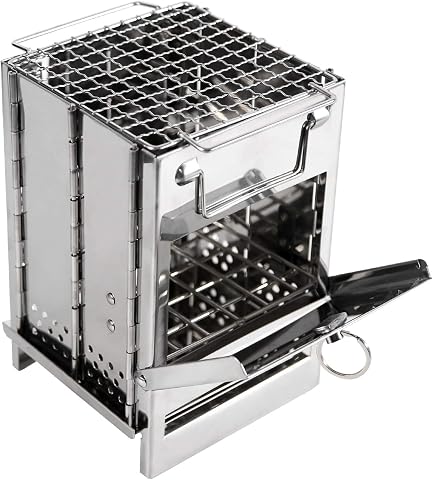
REDCAMP Wood Burning Folding Camp Stove – Portable Collapsible Stainless Steel Backpacking Stove
- ✔ Material: Stainless steel
- ✔ Fuel type: Wood and other suitable natural fuels
- ✔ Weight: 1.9 lb
Difficulty: Beginner | Time: 30-60 minutes to select and test; 5-15 minutes per meal
What You’ll Need
Tools & Materials:
- Compact camping stove and any required fuel
- Compatible pot or pan
- Lighter or matches if the stove does not have a working igniter
- Stable, level, nonflammable outdoor cooking surface
- Water and ingredients for a simple test meal
- Manufacturer instructions for the stove and fuel
Knowledge:
- Basic ability to read product labels and follow safety instructions
- Awareness that stove and fuel compatibility varies by model
Check local fire restrictions and campsite rules before departure. Do not use a camping stove inside a tent, vehicle, or enclosed shelter: combustion can cause carbon monoxide poisoning and fire. Bring only fuel permitted by the transport provider and destination rules. Stove types differ; follow the manufacturer’s instructions whenever they differ from general guidance here.
CAMPINGMOON XD-2F Regulated Canister Top Camping Stove with Z41 Canister Stabilizer
For a compact stove that earns its place in a backpack, the CAMPINGMOON XD-2F kit is the most compelling fit. The burner, Z41 stabilizer, and pouch together weigh 4.15 oz, putting the complete supplied setup in a different carry-weight class from the 1.9 lb REDCAMP wood stove. Its stabilizer also addresses a practical weakness of canister-top designs: a narrow fuel canister can be less reassuring on uneven ground than a broader base.The pressure regulator is the main reason to choose this over a simpler lightweight burner. CAMPINGMOON says it helps maintain consistent gas flow in cold or changing conditions, while the adjustable flame and built-in piezo ignition make heat control and starting more straightforward. It connects to standard EN417 Lindal-valve threaded isobutane canisters, so it is compact and easy to understand, but it is not fuel-flexible like the Gas One. The stated 3.3 kW output is suited to straightforward camp cooking; it is a less convincing match for larger meals, and the stove is not compatible with heat-exchanger cookware.We rank it first because it balances low weight, useful stability, and regulated performance better than the other options here. Skip it if you need a stove that burns multiple fuel types, plan to cook for a larger group, or want to use heat-exchanger pots. As with the other gas options, remember that the stove’s packed weight does not include the fuel canister.
Pros:
- Complete stove and stabilizer kit weighs 4.15 oz.
- Regulator is designed to keep gas flow steadier as conditions change.
- Included three-leg stabilizer adds a wider base for the canister.
- Piezo ignition and adjustable flame control are built in.
Cons:
- Requires compatible EN417 threaded isobutane canisters, which are not listed as included.
- Its 3.3 kW output and cookware limitation make it less suited to larger or specialized cooking setups.
- Designed for outdoor use only.
Best for: Backpackers who prioritize a very light canister setup, want a stabilizer included, and expect to use standard threaded isobutane canisters.
Not ideal for: Campers who need dual-fuel flexibility, cook large meals, use heat-exchanger cookware, or want to avoid carrying a canister.
Bottom line: For weight-conscious trips with simple cooking needs, the CAMPINGMOON offers the strongest balance of compactness, included stability, and regulated canister performance.
“For weight-conscious trips with simple cooking needs, the CAMPINGMOON offers the strongest balance of compactness, included stability, and regulated canister performance.”
Gas One GS-3400P Dual Fuel Portable Camping Stove with Carrying Case
The Gas One GS-3400P is the practical choice when one fuel format is too limiting. It can run on an 8 oz butane cartridge or a 16.4 oz propane cylinder, and the included converter regulator supports the propane option. That range makes it more adaptable than the CAMPINGMOON, which is built around threaded isobutane canisters, and more predictable than REDCAMP when wet conditions make gathering dry wood difficult.Automatic piezo ignition and an adjustable heat dial keep the controls approachable, while the carrying case helps organize the stove and accessories. Its listed safety features are another distinction: for butane use, a pressure-sensor cartridge ejection system and gas-flow cutoff are specified. The ejection system is not stated to work with propane, so we should not treat those protections as identical across both fuel modes. The product information also does not state the stove’s weight or heat output, making it harder to judge against the CAMPINGMOON’s quantified backpacking setup.This stove makes more sense for car camping, a base camp, or a portable backup kit than for carrying deep into a trip. Its dual-fuel design adds options, but the fuel containers themselves take space and are not included. Compared with REDCAMP, it avoids the need to find wood; compared with CAMPINGMOON, it gives up the clearly documented low weight and regulator-focused backpacking case. Choose it for fuel choice and convenient ignition, not because the supplied information establishes it as the lightest option.
Pros:
- Accepts both 8 oz butane cartridges and 16.4 oz propane cylinders.
- Propane converter regulator and carrying case are included.
- Automatic piezo ignition and adjustable heat dial simplify operation.
- Butane mode includes a pressure-sensor ejection system and gas-flow cutoff.
Cons:
- Fuel cartridges and cylinders are not included.
- The specified cartridge ejection safety feature applies to butane, not propane.
- Weight and heat output are not provided in the supplied specifications, limiting backpacking comparisons.
Best for: Campers who want the option to use either butane cartridges or propane cylinders and value a cased, ready-to-transport stove.
Not ideal for: Ultralight backpackers, buyers who want fuel included, or anyone expecting the butane-specific safety system to apply to propane use.
Bottom line: Choose the Gas One when fuel flexibility is more important than a documented ultralight pack weight, while keeping its fuel-specific safety limitations in mind.
“Choose the Gas One when fuel flexibility is more important than a documented ultralight pack weight, while keeping its fuel-specific safety limitations in mind.”
REDCAMP Wood Burning Folding Camp Stove – Portable Collapsible Stainless Steel Backpacking Stove
The REDCAMP takes a different route to compactness: instead of shrinking a gas burner into a tiny package, it folds into a 1.5-inch-thick profile and uses twigs and leaves for fuel. That can be appealing on trips where suitable wood is plentiful and bringing cartridges is inconvenient. Unlike both gas options in this lineup, it does not depend on a compatible canister or a propane converter.That independence has a clear carrying cost. At 1.9 lb, it is far heavier than the 4.15 oz CAMPINGMOON kit, even though its folded form is relatively flat. The REDCAMP’s cuboid body and grid backing plate are intended to create a stable cooking platform, but wood-fired cooking depends on finding usable fuel and managing a fire. Wet conditions can make the fuel hunt harder, and the provided details do not quantify heat output or include an ignition system. We should treat its compact folded dimensions as a packing advantage, not evidence that it is a lightweight backpacking stove.Among these three, REDCAMP is the specialist for campers who prefer a simple stainless-steel wood burner and can reliably source dry natural fuel. It is less convenient than Gas One when you want a controlled, cartridge-fed setup, and much heavier than CAMPINGMOON for a long carry. The product information also notes that residual protective film may need removal before use, an extra preparation step worth checking before the trip.
Pros:
- Burns natural fuels such as twigs and leaves rather than requiring a cartridge.
- Folds to a slim 1.5-inch-thick profile for packing.
- Stainless-steel construction and a grid backing plate provide a sturdy cooking platform.
- Includes a carry bag.
Cons:
- At 1.9 lb, it is much heavier than the CAMPINGMOON canister kit.
- Cooking depends on finding dry, usable natural fuel.
- Protective film may need to be removed before use.
Best for: Campers traveling where dry twigs or leaves are readily available and who want to avoid packing gas cartridges.
Not ideal for: Weight-focused backpackers, trips in wet or fuel-scarce areas, or anyone who wants the convenience of a built-in igniter and controlled canister fuel.
Bottom line: The REDCAMP is a niche but useful pick when natural fuel access matters more than pack weight or the simplicity of a canister-fed flame.
“The REDCAMP is a niche but useful pick when natural fuel access matters more than pack weight or the simplicity of a canister-fed flame.”
As an Amazon Associate we earn from qualifying purchases.
Before You Start
Decide how you will travel and what you will cook. Backpackers usually prioritize low weight and a small packed size; car campers can often choose a larger, more stable stove. Check the stove’s packed dimensions, weight, pot support, ignition method, fuel type, and fuel availability at your destination. Read the stove and fuel instructions before handling the equipment, and test the setup outdoors at home rather than learning to use it at camp.
Fuel systems are not interchangeable. A canister stove requires a compatible threaded or clip-on canister, while liquid-fuel stoves use specific liquid fuels and may need priming. Wood-burning models have separate fire and local-restriction requirements. Never force a connection or substitute fuel. Keep fuel away from flame and heat, and do not refill a disposable fuel canister.
Step-by-Step Instructions
Step 1: Match the stove to your trip
List the number of people, typical meals, expected weather, and transport method. Compare stoves using their packed weight, packed size, cooking capacity, stability, simmer control, setup requirements, and fuel type. Check the manufacturer’s stated pot-size limits and whether the stove includes a pot support or windscreen. Confirm that compatible fuel can be bought near your route or carried under applicable transport rules.
Choose a simple canister stove for straightforward boiling and compact travel if compatible fuel is available. Consider a wider, more stable stove for larger pots or group meals. Choose a liquid-fuel model only if its operating and maintenance steps suit your needs. Do not select solely by minimum weight if the stove will not safely support your cookware.
Tip: A burner advertised as fast is not automatically efficient in wind or cold. Check the maker’s guidance for temperature limits and compatible accessories.
Check: You can name the stove’s compatible fuel, the cookware it can support, and how its size and operation fit your trip.
Step 2: Check the stove and fuel
Lay out the stove, fuel, pot support, and ignition tool on a clear surface. Read the manuals and inspect parts for cracks, dents, corrosion, loose fittings, blocked burner openings, or damaged seals. Check the fuel container’s label, condition, and expiration or service information where applicable. Confirm that the stove connector matches the fuel container exactly and that all required parts are present.
Do not use equipment with a damaged fuel container, faulty seal, bent connector, or unexplained fuel odor. Follow the manufacturer’s instructions for inspection, repair, or replacement; do not attempt an improvised repair.
Tip: Keep the manual or a clear photo of its operating and shutdown instructions with your camping gear.
Check: The stove and fuel are undamaged, all components are present, and the model and fuel instructions agree about compatibility.
Step 3: Practice assembly outdoors
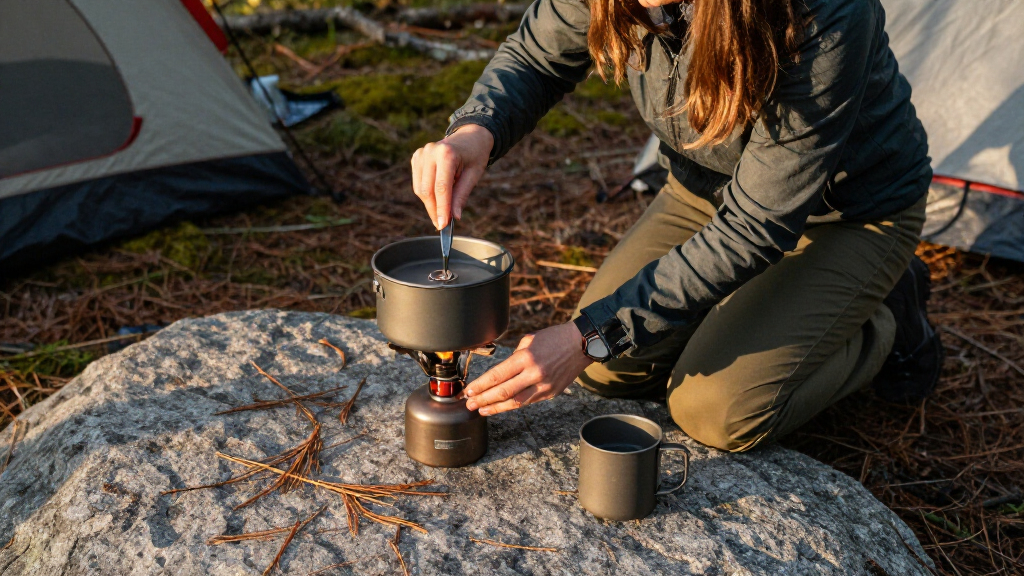
Move the stove to an open outdoor area away from dry grass, overhanging branches, tents, vehicles, and other flammable materials. Set it on a hard, level surface. Assemble the legs and pot supports as directed; attach or position the fuel only in the order specified by the manufacturer. Keep the burner control off while connecting fuel unless the manual states otherwise.
For a canister stove, place the canister in the orientation the instructions specify. Some stoves sit directly on a canister; others connect to a remote canister and must be arranged differently. For liquid-fuel or wood-burning models, follow their separate setup instructions. Do not add a windscreen unless the stove maker approves that exact use.
Tip: A windscreen that traps heat around a fuel canister can cause dangerous overheating. Use only approved screens, positioned as instructed.
Check: The stove stands level without wobbling, its supports are locked in place, and its fuel connection is assembled as the manual shows.
Step 4: Check for fuel leaks and test ignition
Check the connection using the method and leak-detection solution specified by the stove maker. Never check for leaks with a flame. If you smell fuel, hear unexpected hissing, or see bubbles during an approved soapy-water test, turn the stove off if you can do so safely, keep flames and ignition sources away, and follow the manufacturer’s leak instructions. Do not light the stove until the problem is resolved.
If there is no sign of a leak, follow the manual’s lighting sequence. Open the control only as directed, use the built-in igniter or a long lighter, and keep your face and hands away from the burner. If it does not light promptly, turn it off, wait the period specified by the manufacturer for unburned fuel to clear, and try again as instructed. Never keep releasing fuel while attempting to ignite.
Tip: Test the ignition outside, with no food or loose items near the burner. Wind can blow a flame away from the burner and make ignition unreliable.
Check: The stove lights using the prescribed procedure, the flame stays at the burner, and there is no fuel odor or sign of leakage.
Step 5: Cook with a stable pot and controlled flame
Place the stove on a level, stable, nonflammable outdoor surface with clear space around it. Set a compatible pot on the supports before adding flame, and keep handles turned away from walkways. Add water or ingredients within the pot’s safe capacity. Light the stove as practiced, then adjust the control gradually to the heat needed. Stay with the stove while it is burning.
Use only the cookware size and weight allowed by the manufacturer. Do not move a lit stove, leave it unattended, or reach across the flame. Keep fuel containers, clothing, and spare gear away from heat. If wind affects the flame, shelter the cooking area only with a safe, approved arrangement that does not enclose the stove or heat the fuel. Turn off the stove immediately if it becomes unstable or overheats.
Tip: A low flame is usually enough once water boils or food is simmering. Excessive flame can waste fuel and extend beyond the pot.
Check: The pot remains centered and stable, the flame stays controlled beneath it, and food heats without the stove shifting or fuel overheating.
Step 6: Shut down, cool, and pack the stove
Turn off the stove using the manufacturer’s shutdown sequence. If the fuel container disconnects from the stove, wait until the burner is fully extinguished and cool, then disconnect it only as instructed. Never remove a hot fuel canister or place hot parts in a storage bag. Check for residual fuel odor and do not pack equipment that leaks.
Clean cooled cookware and remove food residue from the stove without blocking burner openings. Pack the stove and fuel in their specified protective storage, keeping fuel away from heat and following transport restrictions. Store fuel according to its label and the manufacturer’s directions, not in a hot vehicle or living space.
Tip: Let the stove cool in a protected outdoor spot where children, pets, and passersby cannot touch it.
Check: The flame is out, the stove is cool and clean, no leak or fuel odor is present, and all parts are stored as directed.
Common Mistakes to Avoid
- Packing the stove while it is hot or ignoring a fuel smell. — Shut the stove off, let it cool fully, and investigate any leak signs outdoors before storing or using it again.
Troubleshooting
Problem: The stove will not light.
Solution: Turn off the control and wait for unburned fuel to disperse according to the manual. Check that the fuel is compatible, attached correctly, and not empty; then inspect the igniter and burner for moisture or blockage. Retry only by the prescribed lighting procedure. Stop if you smell fuel or suspect a leak.
Problem: The flame is weak, uneven, or keeps going out.
Solution: Turn the stove off and let it cool before checking fuel level, connection, burner cleanliness, and wind exposure. Follow the manual for cold-weather operation; do not heat the fuel container with a flame or place it near another heat source. Replace damaged parts or contact the manufacturer if the issue remains.
Problem: The stove wobbles or the pot feels unstable.
Solution: Turn off the stove and remove the pot after it is safe to do so. Reposition the stove on firm, level ground, lock the supports into place, and use cookware within the model’s size and weight limits. Do not try to stabilize it with rocks or improvised parts.
Problem: You smell fuel or hear hissing after connecting the stove.
Solution: Do not ignite it. Turn off the control if safe, keep all flames and ignition sources away, and move people back. Follow the manufacturer’s instructions for disconnecting or isolating the fuel outdoors. Do not use the stove again until the leak source is identified and the equipment is repaired or replaced.
What Success Looks Like
The task is complete when you have a stove suited to your trip, confirmed compatibility between stove and fuel, practiced assembly and ignition outdoors, cooked with stable cookware, and shut down and stored the equipment according to its instructions. At camp, success means the stove lights without leaks, holds a steady controlled flame beneath a stable pot, and is fully off and cool before packing.
Next Steps
Before each trip, inspect the stove, seals, supports, igniter, and fuel container, and check current fire restrictions and transport rules. Replace damaged parts only with maker-approved components. After trips, clean and dry the equipment, store fuel as its label directs, and record any ignition or flame problems before the next use. If the stove leaks, has damaged fuel parts, or behaves unpredictably, stop using it and contact the manufacturer or a qualified service provider.
Frequently Asked Questions
Can I use a compact camping stove inside my tent?
No. Do not operate a camping stove inside a tent, vehicle, or enclosed shelter. Fire can spread quickly, and combustion can produce carbon monoxide, which can be fatal. Cook outdoors in an open area.
How do I know which fuel canister fits my stove?
Check the stove manual and product label for the exact fuel type and connector. Compare those specifications with the canister label. Do not guess based on appearance or force a connection.
Can I use a windscreen with any compact stove?
No. Use a windscreen only if the stove maker approves it and follow its placement instructions. A screen that traps heat near a fuel container can overheat it.
What should I do if the stove smells like fuel?
Do not light it. Keep flames and ignition sources away, turn off the stove if safe, and follow the manual’s leak response outdoors. Do not use it again until the cause is fixed and the equipment is confirmed safe.
How should I store a camping stove and its fuel?
Let the stove cool fully, clean and dry it, and store its parts as the manufacturer directs. Store fuel according to its label, away from heat, and follow transport rules. Never leave fuel in a hot vehicle or enclosed living space.
Halloween Picks
halloween
As an affiliate, we earn on qualifying purchases.