For most van conversions, I’d put the Renogy 200W Portable Solar Panel Kit first for its useful balance of portable output and van-friendly flexibility. The DOKIO 300W Foldable Kit is a standout when you need more panel capacity and can manage a larger setup, while the Renogy 100W Foldable Kit suits smaller systems and simpler power needs. The main tradeoff is between portable panels that you can reposition but must set up, and flexible panels that can mount on a roof but are less convenient to move. Controller compatibility, storage space, and how much power you use each day matter as much as the wattage printed on the panel. Read on for my full comparison and advice on choosing a kit for your van.

Get travel and outdoor gear delivered free with Prime
- Fast, free delivery on millions of items
- Prime Video, Amazon Music and more included
- Member-only deals all year
Complete the kit


Key Takeaways
- Renogy’s 200W portable kit is the strongest all-round match for van owners who want useful capacity without moving up to the bulkier 300W DOKIO option.
- The DOKIO 300W kit prioritizes panel capacity, but its larger foldable format calls for more storage and setup space than the 100W and 150W choices.
- Flexible kits address a different van problem: XINPUGUANG and ECO-WORTHY options can suit roof-mounted installations, but they are not as readily repositioned or stored as foldable panels.
- Smaller kits fit light-duty systems rather than every van’s needs; the 60W ZeroKor adds direct USB and DC outputs, while 100W models offer more panel capacity for battery charging.
- Controller and connection details separate similar wattage options: compare included controller types, battery compatibility, and output connections before treating two kits with matching wattage as interchangeable.
| Renogy 200W Portable Solar Panel Kit |  | Best for Portable Ground Deployment | Maximum power: 200 watts | Cell type: N-Type | Conversion efficiency: Up to 25% | VIEW ON AMAZON | See Our Full Breakdown |
| XINPUGUANG 105W Flexible 12V Monocrystalline Solar Panel Kit |  | Best for Lightweight Curved-Surface Mounting | Maximum power: 105 W | Output voltage: 12 V DC | Cell material: Monocrystalline silicon | VIEW ON AMAZON | See Our Full Breakdown |
| DOKIO 300W Portable Foldable Solar Panel Kit with Charge Controller |  | Best for Higher Output on a Portable Budget | Maximum power: 300 watts | Amperage capacity: 16.67 A | Maximum voltage: 18 volts | VIEW ON AMAZON | See Our Full Breakdown |
| ECO-WORTHY 260W Flexible Solar Panel Kit with 30A Charge Controller |  | Best Flexible Kit for Broader Battery Compatibility | Total maximum power: 260W | Panel power: 130W each | Output voltage: 12V DC | VIEW ON AMAZON | See Our Full Breakdown |
| XINPUGUANG 200W Flexible Solar Panel Kit with 20A Controller |  | Best Flexible Option for a Compact Roof Layout | Maximum power: Product details list 105W, 200W, and 210W | Output voltage: 12 volts DC | Panel dimensions: 43.1 x 21.65 x 0.11 inches | VIEW ON AMAZON | See Our Full Breakdown |
| ECO-WORTHY 200W 12V/24V Monocrystalline Solar Panel Kit with 30A PWM Charge Controller |  | Best for a Fixed Roof-Mount Setup | Panel configuration: 2 × 100W monocrystalline panels | Output voltage: 12V DC; panels can be wired for 12V or 24V | Charge controller: 30A PWM | VIEW ON AMAZON | See Our Full Breakdown |
| DOKIO 100W Portable Foldable Solar Panel Kit for 12V Batteries |  | Best Lightweight Companion Panel | Maximum power: 110 watts | Output voltage: 12V DC | Maximum voltage: 18V | VIEW ON AMAZON | See Our Full Breakdown |
| Renogy 100W Portable Foldable Solar Panel Kit with 20A Charge Controller |  | Best for a More Protective Portable Panel | Maximum power: 100 watts | Cell efficiency: Up to 25% | Output voltage: 12V | VIEW ON AMAZON | See Our Full Breakdown |
| DOKIO 150W Portable Foldable Solar Panel Kit with Charge Controller | 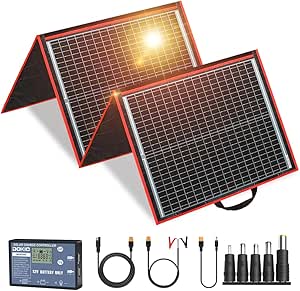 | Best Portable Capacity-to-Weight Balance | Maximum power: 160 watts | Output voltage: 12V DC | Maximum voltage: 18V | VIEW ON AMAZON | See Our Full Breakdown |
| ZeroKor 60W Foldable Portable Solar Panel with USB-A, USB-C, and DC Outputs |  | Best for Small Devices and Compact Storage | Maximum power: 60 watts | Solar cell efficiency: 20.5% | DC output: 18V, 3.3A maximum | VIEW ON AMAZON | See Our Full Breakdown |
| DOKIO 200W Portable Foldable Solar Panel Kit for 12V Batteries |  | Best Lightweight 200W Pick | Maximum power: 220 watts | Output voltage: 12 volts DC | Amperage capacity: 6.1 A | VIEW ON AMAZON | See Our Full Breakdown |
| Renogy 200W 12V Portable Foldable Solar Panel Suitcase with Waterproof 20A Charge Controller |  | Best Rugged Suitcase Kit | Power output: 200W | System voltage: 12V | Cell type: N-Type | VIEW ON AMAZON | See Our Full Breakdown |
| ZOUPW 100W Foldable Portable Solar Panel |  | Best Compact Device-Charging Panel | Maximum power: 100 W | Cell efficiency: 23.5% | Maximum voltage: 24.3 V | VIEW ON AMAZON | See Our Full Breakdown |
| Go Power GP-PSK-130 130W Portable RV Solar Panel Kit |  | Best for AGM and Lithium Battery Compatibility | Maximum power: 130 W | Amperage capacity: 6.7 A | Maximum voltage: 19.7 V | VIEW ON AMAZON | See Our Full Breakdown |
| portable solar panel kit for van conversion | Maximum power | Output voltage | Weight | Maximum voltage |
|---|---|---|---|---|
| Renogy 200W Portable Solar Pan | 200 watts | 18.65 volts | 28.5 pounds | 21.47 volts |
| XINPUGUANG 105W Flexible 12V M | 105 W | 12 V DC | Approximately 4 lb | — |
| DOKIO 300W Portable Foldable S | 300 watts | 12V DC | 15.2 pounds | 18 volts |
| ECO-WORTHY 260W Flexible Solar | — | 12V DC | — | 21.1V |
| XINPUGUANG 200W Flexible Solar | Product details list 105W, 200W, and 210W | 12 volts DC | — | — |
| ECO-WORTHY 200W 12V/24V Monocr | — | 12V DC; panels can be wired for 12V or 24V | — | — |
| DOKIO 100W Portable Foldable S | 110 watts | 12V DC | 6 pounds | 18V |
| Renogy 100W Portable Foldable | 100 watts | 12V | 17.4 pounds | 21.47V |
| DOKIO 150W Portable Foldable S | 160 watts | 12V DC | 7.3 pounds in description; 9 pounds in specifications | 18V |
| ZeroKor 60W Foldable Portable | 60 watts | — | 4.2 pounds | — |
| DOKIO 200W Portable Foldable S | 220 watts | 12 volts DC | 9.7 pounds | — |
| Renogy 200W 12V Portable Folda | — | — | — | — |
| ZOUPW 100W Foldable Portable S | 100 W | 20.16 V | 9.5 lb | 24.3 V |
| Go Power GP-PSK-130 130W Porta | 130 W | — | 28.7 lb | 19.7 V |
More Details on Our Top Picks
Renogy 200W Portable Solar Panel Kit
For a van conversion where panels need to move between the roof and a sunny campsite, I’d favor this foldable 200W kit over the fixed-mount XINPUGUANG flexible panels. Its adjustable kickstand lets me aim the panel toward the sun, while N-Type cells are rated for up to 25% conversion efficiency. The included controller supports 12V battery setups, and the kit is also described as compatible with many power stations, giving it flexibility beyond a permanent van installation.
The tradeoff is its 28.5-pound weight: it is portable, but not an especially light panel to move around daily. It also uses MC4 output cables, and the 4-in-1 adapter is sold separately, so power-station buyers should check connector compatibility before setting out. Compared with the lighter DOKIO 300W foldable kit, this Renogy offers a higher stated conversion efficiency but less rated wattage.
Pros:- Adjustable kickstand helps aim the panel at changing sunlight.
- N-Type cells have a stated conversion efficiency of up to 25%.
- Works with 12V battery systems and many power stations.
- Tempered-glass and aluminum construction with an IP65-rated junction box.
Cons:- At about 28.5 pounds, it is heavier to reposition than the flexible kits.
- MC4 output cables may require an adapter for a power station.
- The 4-in-1 adapter cable is sold separately.
Best for: Van owners who want to set a panel outside the vehicle, angle it toward the sun, and charge a 12V battery or compatible power station.
Not ideal for: Builders looking for a lightweight roof-mounted panel or a ready-to-connect power-station kit, since it weighs 28.5 pounds and the 4-in-1 adapter is separate.
- Maximum power:200 watts
- Cell type:N-Type
- Conversion efficiency:Up to 25%
- Amperage capacity:11.89 A
- Maximum voltage:21.47 volts
- Output voltage:18.65 volts
- Weight:28.5 pounds
- Dimensions:34.25 x 1.57 x 22.83 inches
- Warranty:5 years
Our verdict“Choose this Renogy if you want a durable, adjustable ground-deployed panel and can accommodate its weight and connector requirements.”
XINPUGUANG 105W Flexible 12V Monocrystalline Solar Panel Kit
This is the most practical match here for a van with a curved or irregular mounting area: the panel weighs about 4 pounds, is just 0.11 inches thick, and can flex to a stated 250-degree arc. That makes it easier to handle than the rigid Renogy 200W portable panel, though it serves a different purpose: this XINPUGUANG is a low-profile mounting option, not a fold-out panel with a kickstand for repositioning.
The included 10A controller supports lead-acid, gel, and lithium phosphate batteries, so the kit can fit several common van battery types. Its 105W output is better suited to topping up a modest system than powering a high-demand conversion alone. I’d also be cautious about the product information’s conflicting 100W and 105W figures, and the stated daily output assumes five hours of intense sunlight. Unlike the DOKIO 300W, it cannot offer comparable rated capacity for larger loads.
Pros:- Approximately 4-pound weight is easy to handle during installation.
- Flexible construction can suit curved or irregular surfaces.
- Includes a 10A charge controller and connection leads.
- Controller supports lead-acid, gel, and lithium phosphate batteries.
Cons:- The product information conflicts between 100W and 105W ratings.
- Its stated daily output assumes five hours of intense sunlight.
- A 105W panel provides less rated capacity than the 200W and 300W options.
Best for: Van builders with a curved roof section who want a thin, light panel for a modest 12V battery system.
Not ideal for: Van owners who need high daily energy production, a portable ground-deployment setup, or fully consistent wattage specifications.
- Maximum power:105 W
- Output voltage:12 V DC
- Cell material:Monocrystalline silicon
- Conversion rate:Up to 23%
- Dimensions:43.1 × 21.65 × 0.11 inches
- Weight:Approximately 4 lb
- Maximum bend:250-degree arc
- Charge controller:10 A
- Battery compatibility:Lead-acid, gel, and lithium phosphate
Our verdict“Pick this kit for lightweight, curved-surface mounting and modest power needs, but verify the wattage and plan around variable sunlight.”
DOKIO 300W Portable Foldable Solar Panel Kit with Charge Controller
The DOKIO stands out for pairing a 300W rating with a foldable package that weighs 15.2 pounds. For a van owner who needs to set panels outside the vehicle, that higher rated output can suit a larger battery setup better than the 200W Renogy or the flexible 260W ECO-WORTHY kit. It also arrives with a standalone PWM controller, a 9.85-foot cable, USB ports, adapters, and a storage bag, reducing the number of connection pieces I’d need to source separately.
Its practical limit is that 300W is not guaranteed usable input: some power stations cap incoming solar power below that level, so the panel’s full rating may go unused. The fabric case also needs protection from heavy rain and prolonged strong sun. Compared with the Renogy 200W, DOKIO gives more stated wattage for less weight, but its one-year warranty is shorter than Renogy’s five-year warranty.
Pros:- 300W maximum rating offers more nominal capacity than the 200W Renogy.
- Foldable format weighs 15.2 pounds for its stated output.
- Includes a PWM controller, 9.85-foot cable, adapters, USB ports, and storage bag.
- Controller protection includes overcharge, overload, reverse-polarity, and short-circuit safeguards.
Cons:- Some power stations may not accept the panel’s full 300W rated input.
- The fabric case needs shelter from heavy rain and prolonged strong sun.
- The one-year warranty is shorter than the five-year coverage listed for the Renogy 200W.
Best for: Van owners with a 12V battery or compatible power station who want a foldable panel with higher rated output and included connection accessories.
Not ideal for: Buyers who need a permanently roof-mounted panel, a weather-exposed setup, or a power station whose solar input limit is well below 300W.
- Maximum power:300 watts
- Amperage capacity:16.67 A
- Maximum voltage:18 volts
- Output voltage:12V DC
- Material:Monocrystalline silicon
- Folded size:19.3 × 37.4 × 1.1 inches
- Weight:15.2 pounds
- Cable length:9.85 feet (3 m)
- Warranty:1 year
Our verdict“Choose the DOKIO when foldable portability and higher rated output matter more than roof mounting or long warranty coverage.”
ECO-WORTHY 260W Flexible Solar Panel Kit with 30A Charge Controller
This ECO-WORTHY kit makes sense for a van owner who wants flexible panels installed on a roof and a controller that can serve a range of battery chemistries. Its two 130W panels total 260W, while the included 30A PWM controller supports lead-acid, gel, and lithium phosphate batteries. Against the single-panel XINPUGUANG 105W kit, this set offers substantially more rated capacity and includes Y-branch connectors and a tray cable for wiring the two panels together.
Each panel weighs 4.5 pounds, a clear handling advantage over the rigid Renogy 200W portable kit, but the stated up to 1,040Wh per day depends on four hours of full sunlight. The panels are flexible rather than foldable, so this is better suited to a roof installation than moving in and out of the van. It also ships in two packages, which may mean the components arrive separately.
Pros:- Two 130W panels provide 260W of combined rated power.
- Each panel weighs 4.5 pounds and is only 0.1 inches thick.
- Includes a 30A PWM controller, cables, Y-branch connectors, and fuse.
- Controller supports lead-acid, gel, and lithium phosphate batteries.
Cons:- The stated daily output assumes four hours of full sunlight.
- Flexible panels are better suited to mounting than frequent ground deployment.
- The order ships in two separate packages.
Best for: Van builders mounting panels on a flexible or uneven roof who want a two-panel kit and a controller compatible with several battery types.
Not ideal for: Travelers who want to angle a panel at a campsite, need a single compact fold-out unit, or expect the stated daily output regardless of weather.
- Total maximum power:260W
- Panel power:130W each
- Output voltage:12V DC
- Maximum voltage:21.1V
- Efficiency:22.4%
- Daily output:Up to 1,040Wh under four hours of full sunlight
- Panel dimensions:37.78 x 27.17 x 0.1 inches
- Panel weight:4.5 lbs each
- Charge controller:30A PWM with LCD display
Our verdict“Choose this ECO-WORTHY kit for a roof-mounted flexible array with a versatile controller, not for a panel you plan to reposition each day.”
XINPUGUANG 200W Flexible Solar Panel Kit with 20A Controller
For a van roof that cannot take a rigid panel, this XINPUGUANG kit offers a thin, flexible format with a stated 250-degree bend and a 20A controller. Its listed 43.1 x 21.65-inch panel footprint can suit builders working around roof features, while the included parallel connectors, alligator-clip cable, and extension cable give the kit more connection pieces than the smaller XINPUGUANG 105W set. Battery compatibility covers lead-acid, gel, and lithium phosphate.
Specifications need a careful read: the product information lists conflicting wattage figures of 105W, 200W, and 210W, so I would not plan a van’s daily power budget around the 200W title alone. The stated output also depends on about five hours of intense sunlight. Compared with ECO-WORTHY’s clearly itemized 260W two-panel kit, this option is less certain on capacity, though its single flexible panel may suit a constrained mounting layout.
Pros:- Flexible panel can conform to curved or irregular mounting surfaces.
- Thin, lightweight construction is easier to handle than rigid glass panels.
- Includes a 20A controller and parallel connectors, plus extension and battery leads.
- Controller supports lead-acid, gel, and lithium phosphate batteries.
Cons:- Product details conflict between 105W, 200W, and 210W ratings.
- Expected daily output depends on about five hours of intense sunlight.
- A flexible fixed-mount panel cannot be repositioned like the foldable DOKIO or Renogy kits.
Best for: Van builders who need a thin flexible panel for a curved or space-constrained roof and can confirm the actual rated output before purchase.
Not ideal for: Buyers who need dependable wattage figures for sizing a battery system or who want a portable fold-out panel for campsite positioning.
- Maximum power:Product details list 105W, 200W, and 210W
- Output voltage:12 volts DC
- Panel dimensions:43.1 x 21.65 x 0.11 inches
- Cell material:Monocrystalline silicon
- Cell conversion rate:Up to 23%
- Maximum curvature:250-degree arc
- Charge controller:20A
- Battery compatibility:Lead-acid, gel, and lithium phosphate
Our verdict“Consider this kit for a space-limited curved roof only after confirming its actual wattage and matching it to your battery plan.”
ECO-WORTHY 200W 12V/24V Monocrystalline Solar Panel Kit with 30A PWM Charge Controller
For a van conversion built around a permanent roof array, this kit offers 200 watts across two rigid panels, plus mounting brackets, cables, and a 30A PWM controller. The two-panel layout gives you wiring flexibility: connect in parallel for 12V or in series for 24V, which is useful when matching a system design rather than relying on a single portable panel. Compared with the DOKIO 150W Portable Foldable Kit, ECO-WORTHY is better suited to mounting and leaving in place, but it gives up the convenience of folding panels you can reposition outside the van. Its 31.6-pound combined weight and roughly 35-by-23-inch panels call for planned roof space and secure mounting. I’d choose it for a simple fixed installation, not frequent pack-up and repositioning.
Pros:- Two 100W panels provide 200W of rated capacity for a fixed van array.
- Can be wired in parallel for 12V or series for 24V systems.
- Includes Z brackets, cables, connectors, and a 30A PWM controller.
- Aluminum-alloy frames and stated wind and snow load resistance suit outdoor mounting.
Cons:- At 31.6 pounds, the kit adds substantial roof load and takes planning to handle and mount.
- Rigid panels cannot be repositioned away from a shaded van as easily as foldable options.
- The PWM controller is a basic charge-control choice rather than an MPPT controller.
Best for: Van builders who want a two-panel, roof-mounted 200W array with included mounting hardware and the option to wire for 12V or 24V.
Not ideal for: Renters, minimal-roof-space builds, or travelers who need to set panels outside the van for better sun exposure; these rigid panels are not a fold-away portable setup.
- Panel configuration:2 × 100W monocrystalline panels
- Output voltage:12V DC; panels can be wired for 12V or 24V
- Charge controller:30A PWM
- Panel dimensions:35.2 × 23.1 × 1.3 inches each
- Kit weight:31.6 pounds
- Connectors:MC4
- Included components:Two panels, Z brackets, charge controller, solar cables, 2-in-1 connectors, and tray cable
Our verdict“Choose this kit if you want a complete, fixed 200W roof array and do not need the repositioning convenience of a foldable panel.”
DOKIO 100W Portable Foldable Solar Panel Kit for 12V Batteries
The DOKIO 100W is the easiest option here to carry from a van to a sunny patch: it weighs 6 pounds, folds to a slim form, and includes a 9.84-foot cable so the panel can sit away from shade. Its standalone PWM controller and several connection types make it adaptable to a 12V battery setup, while built-in USB ports can handle small devices. Against the Renogy 100W Portable Foldable Kit, DOKIO is much lighter and easier to stow, though Renogy adds an adjustable kickstand and a more protective rigid-panel construction. The tradeoff is capacity: 110W maximum power is better for topping up a modest battery than carrying a van’s daily electrical load. Check a power station’s input limit before connecting it, since the station may cap the panel’s output.
Pros:- Six-pound weight makes it easier to carry and reposition than the Renogy 100W foldable kit.
- Folds compactly for storage inside a van.
- Includes a standalone PWM controller and a 9.84-foot cable.
- SAE, XT60, DC, and alligator-clip connections offer useful setup flexibility.
Cons:- Its 110W maximum output is modest for running a van’s regular electrical loads.
- PWM charging and variable sunlight limit how much energy it can deliver in a day.
- Some power stations may restrict its input below the panel’s rated capability.
Best for: Solo van travelers who need a lightweight panel for occasional battery top-ups and phone charging, with a setup that stores easily between stops.
Not ideal for: Van owners who depend on solar as their main daily power source or need a rigid, weather-resistant panel that can stay deployed in changing conditions.
- Maximum power:110 watts
- Output voltage:12V DC
- Maximum voltage:18V
- Amperage capacity:6.1A
- Weight:6 pounds
- Folded dimensions:18.9 × 26 × 0.47 inches
- Cable length:9.84 feet
- Controller and connectors:Standalone PWM controller; SAE, XT60, DC, and alligator clips
Our verdict“Pick the DOKIO if low carry weight and compact storage matter more than getting the highest daily solar harvest.”
Renogy 100W Portable Foldable Solar Panel Kit with 20A Charge Controller
Renogy’s 100W kit is a portable option for van owners who want a rigid glass-and-aluminum panel with an adjustable kickstand rather than the lighter fabric-style DOKIO panels. The kickstand helps angle the panel toward the sun when the van is parked in shade, while the included 20A PWM controller and alligator-clip leads provide a direct route to compatible 12V batteries. Its stated cell efficiency of up to 25% is a useful specification, but the 100W rating still sets a modest ceiling for a van’s energy harvest. Compared with the DOKIO 100W Portable Foldable Kit, Renogy is heavier at 17.4 pounds and less convenient to carry, but its tempered-glass face is a more substantial outdoor surface. I’d favor it for careful, stationary deployment over frequent packing and repositioning.
Pros:- Adjustable kickstand lets users angle the panel toward available sunlight.
- Includes a 20A PWM charge controller and alligator-clip cables.
- Tempered-glass surface, aluminum frame, and IP65-rated junction box are designed for outdoor use.
- Five-year warranty is longer than the one-year coverage listed for both DOKIO portable kits.
Cons:- At 17.4 pounds, it is substantially heavier than the 6-pound DOKIO 100W panel.
- Its 100W rating is limited for powering several van loads or replenishing a large battery.
- Charging depends on sun exposure and careful positioning, so it cannot provide steady output in shade.
Best for: Van owners who want a portable 100W panel with a kickstand and a rigid glass surface for occasional battery charging at camp.
Not ideal for: Travelers who need a lightweight panel to carry frequently, or builds that need more than 100W from a single portable unit.
- Maximum power:100 watts
- Cell efficiency:Up to 25%
- Output voltage:12V
- Maximum voltage:21.47V
- Charge controller:20A PWM
- Weight:17.4 pounds
- Folded size:24.8 × 2 × 2.8 inches
- Surface and enclosure:Low-iron tempered glass; IP65-rated junction box
Our verdict“Choose Renogy if a kickstand and rigid outdoor construction matter more than light weight or higher panel capacity.”
DOKIO 150W Portable Foldable Solar Panel Kit with Charge Controller
For van owners who want more portable output than a 100W panel without moving up to a heavier rigid kit, this DOKIO is a practical middle ground. It is listed at 160W maximum power, folds into a compact package, and includes a detachable PWM controller, cable set, adapters, and storage bag. Its roughly 9.8-foot lead helps keep the panel in sun while the van or connected gear stays shaded. Compared with the ECO-WORTHY 200W kit, this option sacrifices the higher capacity and fixed-mount hardware but is much easier to move between parking spots and sunny ground. Power-station owners should check the station’s input limits, and the polyester case should be protected from heavy rain and prolonged strong sun. The listed weight varies between 7.3 and 9 pounds, so plan for the heavier figure.
Pros:- Higher stated maximum output than the DOKIO 100W model while remaining foldable.
- Detachable PWM controller includes reverse-polarity, overcharge, overload, and short-circuit protection.
- Long cable supports placing the panel in sunlight while the van remains shaded.
- Includes USB ports, adapters, cables, and a storage bag.
Cons:- Power stations may limit input below the panel’s stated maximum.
- The polyester case is not suited to heavy rain or prolonged strong sunlight.
- Published weight is inconsistent, listed as 7.3 pounds in the description and 9 pounds in the specifications.
Best for: Van travelers who want a portable panel with more rated capacity than a 100W kit and need to reposition it away from a shaded vehicle.
Not ideal for: Builders seeking a permanent roof array, or campers who need a rigid panel and case suited to extended exposure to harsh weather.
- Maximum power:160 watts
- Output voltage:12V DC
- Maximum voltage:18V
- Amperage capacity:8.89A
- Folded dimensions:19.3 × 20.9 × 1.1 inches
- Weight:7.3 pounds in description; 9 pounds in specifications
- Cable lengths:9.8 feet and 3.3 feet
- Controller and connectors:Detachable PWM controller; SAE, XT60, DC, and alligator clip
Our verdict“Pick this DOKIO for a movable, higher-capacity panel when portability matters more than a permanent roof installation.”
ZeroKor 60W Foldable Portable Solar Panel with USB-A, USB-C, and DC Outputs
ZeroKor is the compact pick for van owners who mainly want solar for phones, tablets, and a compatible power station—not a panel to carry the van’s core electrical loads. At 4.2 pounds, it is the lightest option in this group, and its USB-A, USB-C, and DC outputs allow direct charging without adding a separate controller for small devices. A kickstand and carry bag make quick deployment straightforward. Compared with the DOKIO 100W Portable Foldable Kit, ZeroKor is smaller and offers USB-C output, but its 60W maximum power leaves less headroom for replenishing a house battery. Its connector box is not waterproof even though the panel surface is IP65-rated, so I would keep the connections sheltered and verify voltage compatibility before pairing it with a power station.
Pros:- At 4.2 pounds, it is lighter than the other portable kits in this group.
- USB-A, USB-C, and DC outputs support a range of small devices and compatible equipment.
- Includes a kickstand and carry bag for easy setup and storage.
- Smart IC adjusts charging for connected devices.
Cons:- The 60W maximum output is below the 100W and higher kits, limiting battery-charging capacity.
- The connector box is not waterproof, so connections need shelter from rain.
- Power-station voltage compatibility must be checked before use.
Best for: Minimalist van travelers who want a lightweight panel for charging handheld devices and topping up a compatible small power station.
Not ideal for: Van owners who need to charge a house battery quickly or rely on solar to support several daily electrical loads.
- Maximum power:60 watts
- Solar cell efficiency:20.5%
- DC output:18V, 3.3A maximum
- USB-A output:5V/3A, 9V/2A, or 12V/1.5A
- USB-C output:5V/3A, 9V/3A, 12V/2A, or 15V/2A
- Weight:4.2 pounds
- Folded dimensions:14.96 × 9.78 × 0.77 inches
- Water resistance:IP65-rated panel surface; connector box is not waterproof
Our verdict“Choose ZeroKor for lightweight device charging and compact storage, but pick a higher-wattage kit for meaningful van-battery charging.”
DOKIO 200W Portable Foldable Solar Panel Kit for 12V Batteries
The DOKIO suits van owners who want substantial panel capacity without hauling a rigid suitcase around camp. At 9.7 pounds, it is far lighter than the Renogy 200W suitcase, which weighs 28.46 pounds, making the DOKIO easier to move between a sunny parking spot and storage. Its 9.84-foot cable also gives you room to place the panel away from the van’s shade while keeping the battery or controller nearby.
The tradeoff is its separate PWM controller, rather than an MPPT setup, and the stated 6.1A capacity means real charging output depends on conditions and system compatibility. Some power stations may also cap incoming power below the panel’s capacity. I’d choose it for lightweight portability, not as a fixed rooftop solution; the ZOUPW 100W is a simpler direct-device option but offers less panel capacity.
Pros:- At 9.7 pounds, it is easier to carry and reposition than the heavier Renogy 200W suitcase.
- Folds into a thin package for storage inside a van.
- The 9.84-foot cable helps place the panel in sun while the van remains shaded.
- Separate controller includes safety protections, and dual USB ports can charge small devices.
Cons:- The PWM controller may be less efficient than an MPPT controller in some setups.
- Some power stations may accept less than the panel’s maximum capacity.
- USB output can vary in direct sunlight when no battery is connected.
Best for: Van owners with a compatible 12V battery who want a light, stowable panel for topping up while parked.
Not ideal for: Drivers seeking a permanent roof-mounted array, an MPPT controller, or guaranteed full panel input from a power station with a low input limit.
- Maximum power:220 watts
- Output voltage:12 volts DC
- Amperage capacity:6.1 A
- Weight:9.7 pounds
- Folded dimensions:20 x 27 x 1.1 inches
- Cable length:9.84 feet (3 m)
- Controller:PWM charge controller
- Ports:Dual USB
Our verdict“Choose the DOKIO if low carry weight matters more than a suitcase-style frame or an MPPT controller.”
Renogy 200W 12V Portable Foldable Solar Panel Suitcase with Waterproof 20A Charge Controller
For van owners who frequently set up and pack away their solar gear, the Renogy’s suitcase format is more structured than the lightweight DOKIO 200W foldable panel. It pairs 200W of output with an adjustable aluminum kickstand, so you can angle the panels toward the sun instead of laying them flat beside the van. The tempered glass, anti-corrosion frame, and IP65-rated junction box favor a more durable portable setup, while the included waterproof 20A PWM controller and alligator clips make 12V battery connections straightforward.
That sturdier package comes with a real carrying penalty: at 28.46 pounds, it is nearly three times the DOKIO’s listed weight. Its PWM controller is also a less efficient choice than MPPT alternatives. I’d pick it for a van owner who values a framed, self-supporting kit and a longer warranty over easy one-handed handling; the 100W ZOUPW is lighter but has half the rated panel output.
Pros:- Adjustable kickstand makes it easier to aim the panels at available sunlight.
- Includes a waterproof 20A PWM controller and alligator-clip cables for battery connections.
- Tempered glass, an anti-corrosion aluminum frame, and an IP65 junction box suit repeated outdoor setup.
- Five-year materials and workmanship warranty is longer than the 12-month warranty listed for the ZOUPW.
Cons:- At 28.46 pounds, it is substantially heavier than the DOKIO 200W foldable panel.
- The PWM controller may deliver less charging efficiency than an MPPT controller.
- Its suitcase form requires more storage space than a thin folding panel.
Best for: Van owners who want a framed, adjustable portable array for charging compatible 12V batteries and can manage a heavier case.
Not ideal for: Solo travelers with limited storage or anyone who needs a lightweight panel to carry frequently between the van and a distant sunny spot.
- Power output:200W
- System voltage:12V
- Cell type:N-Type
- Maximum conversion efficiency:25%
- Charge controller:Waterproof 20A PWM, 4-stage charging
- Folded weight:28.46 lbs (12.91 kg)
- Frame:Anti-corrosion aluminum
- Warranty:5 years
Our verdict“Pick the Renogy for a durable, angle-adjustable 200W suitcase kit if its weight and storage footprint suit your van.”
ZOUPW 100W Foldable Portable Solar Panel
The ZOUPW is the compact pick for van owners who want a portable panel for smaller power stations and direct device charging, rather than a high-output battery-charging kit. Its USB-C and USB-A ports let you charge compatible electronics without routing everything through a separate controller, and the included five-connector, 10-foot cable broadens power-station compatibility. Adjustable kickstands help aim the panel when parked, while the IP67 panel protection adds reassurance for outdoor use.
At 100W, it has half the rated output of the Renogy 200W suitcase, so it is a better match for modest loads than a van with larger daily energy needs. Its 9.5-pound weight is close to the DOKIO 200W’s 9.7 pounds, though the DOKIO provides substantially more listed panel capacity. The ZOUPW’s controller and cables are kept in a pocket, but the IP67 claim applies to the panel, not those accessories.
Pros:- USB-C and USB-A outputs support direct charging of compatible small devices.
- Five-in-one connector cable offers several connection options for power stations.
- Adjustable kickstands help position the panel toward the sun.
- IP67 protection is specified for the panel, and its folded design suits portable storage.
Cons:- Its 100W rating offers less capacity than the DOKIO and Renogy 200W kits.
- Charging speed depends on sunlight and the connected power station’s input limit.
- The controller and cables are stored in a pocket and are not covered by the panel’s IP67 rating.
Best for: Van owners with a compatible portable power station who want a compact panel that can also charge phones and small electronics directly.
Not ideal for: Travelers trying to replenish a large 12V house battery quickly or those who need every component, including cables and controller, to share the panel’s IP67 protection.
- Maximum power:100 W
- Cell efficiency:23.5%
- Maximum voltage:24.3 V
- Output voltage:20.16 V
- Weight:9.5 lb
- Folded dimensions:24.13 × 21.06 × 1.77 in
- Ports:1 USB-C (PD 15 V/3 A), 2 USB-A (including QC3.0 12 V/1.5 A)
- Included cable:5-in-1 solar connector cable, 10 ft
- Warranty:12 months
Our verdict“Choose the ZOUPW for compact power-station and device charging, but choose a 200W kit if your van battery needs more solar input.”
Go Power GP-PSK-130 130W Portable RV Solar Panel Kit
The Go Power GP-PSK-130 makes sense for van owners who want a portable kit with stated support for both AGM and lithium batteries. Its adjustable legs help set the panel’s angle at camp, and the included nylon case gives the folding kit a dedicated place to live between stops. Multiple connection options also give it a flexible role across RV, marine, and van setups, rather than limiting it to one use case.
At 130W, it sits between the ZOUPW 100W and the two 200W options in this roundup: more output than the compact ZOUPW, but less rated capacity than the DOKIO or Renogy. It is not especially easy to carry at 28.7 pounds, nearly matching the heavier Renogy suitcase despite its lower output. I’d choose it for battery-type flexibility and portable positioning, not for a lightweight kit or maximum panel capacity.
Pros:- Supports AGM and lithium batteries, covering two common van battery types.
- Adjustable legs let you angle the panel toward sunlight while parked.
- Folding design and included nylon case support storage and transport.
- Multiple connection options suit RV, camping, and marine setups.
Cons:- At 28.7 pounds, it is heavy to move and nearly as heavy as the Renogy 200W suitcase.
- Its 130W rating is below the 200W capacity of the DOKIO and Renogy kits.
- The provided product data does not specify a charge controller or detail the multiple connection options.
Best for: Van owners with an AGM or lithium battery who want adjustable portable solar and a storage case for occasional campsite charging.
Not ideal for: Buyers prioritizing low carry weight, high output per carried pound, or a clearly specified charge controller and connection package.
- Maximum power:130 W
- Amperage capacity:6.7 A
- Maximum voltage:19.7 V
- Connector type:MC4
- Dimensions:39.8 × 1.4 × 32.5 in
- Weight:28.7 lb
- Material:Nylon
- Model number:GP-PSK-130
Our verdict“Choose the Go Power if AGM-and-lithium compatibility and adjustable campsite setup matter more than low weight or 200W output.”

How We Picked
I ranked these kits for real van-conversion use, where panel output is only part of the decision. My criteria included stated wattage, portability and storage demands, whether a panel is foldable or flexible, the included charge controller, battery-system compatibility, and the usefulness of available outputs. I also weighed how readily a kit could fit different van routines: a panel set outside at camp, a supplementary charging source, or a roof-mounted installation.
The order reflects fit and tradeoffs, not wattage alone. I favored options that balance practical power with manageable setup and clear van use, then placed more specialized choices according to the needs they serve. A higher-wattage panel does not automatically rank above a smaller one if its size, mounting style, or system requirements make it a poorer fit for many conversions. The product details here are based on the listed specifications, not claims of hands-on testing.
Factors to Consider When Choosing Portable Solar Panel Kit For Van Conversion
Before choosing a kit, I’d start with your van’s power plan and how you expect to use the panels. These broader checks can prevent common mismatches that wattage comparisons alone won’t catch.
Match Panel Capacity to Your Daily Loads
List the devices you expect to run and estimate their daily energy use rather than choosing a panel by wattage alone. A small kit may help maintain a modest battery setup, but regular use of a fridge, fans, or multiple electronics can call for more charging capacity. Panel ratings describe output under specified conditions, not a guaranteed daily energy total from your van roof or campsite. Shade, season, panel angle, and available daylight all affect what reaches the battery. Leave room for cloudy days or longer stays away from a plug, rather than designing around perfect sun. If your energy needs are still unclear, measuring usage before buying can prevent both an undersized kit and an unnecessarily cumbersome one.
Choose Between Foldable Portability and Roof-Mounted Flexibility
A foldable panel can be set in the sun while the van is parked in shade, a useful advantage in campsites with awkward exposure. That freedom comes with setup and packing each time, plus a need for safe storage inside the van while driving. Flexible panels can suit a permanent roof installation where reducing setup steps matters more than repositioning the panel. Roof mounting also makes placement, wiring, and access for maintenance part of the installation plan. Don’t choose flexible panels solely because their profile looks convenient; confirm the intended mounting method and roof conditions match the product. For many conversions, the real choice is daily convenience versus the ability to move the panel to better sunlight.
Check the Controller and Battery-System Match
The included charge controller affects whether a kit can work with your battery setup and how it should be connected. Confirm the controller supports your battery’s voltage and chemistry before purchase; a panel’s stated 12V or 24V compatibility does not answer every battery question. Compare controller type and rated capacity with the panel output, and check whether the kit includes the cables or adapters your installation needs. Some kits also offer direct device outputs, but those are not a substitute for a properly planned battery-charging system. A controller bundled with a panel can simplify a basic setup, while a more developed van electrical system may call for a separately selected controller. Check the product documentation rather than assuming accessories are interchangeable.
Plan for Shade, Placement, and Cable Routing
In a van, the best place to park for comfort may not be the sunniest place for a panel. A portable kit can help resolve that conflict if its cable can reach a sunny patch without creating a trip hazard or leaving the panel vulnerable to theft. Before buying, think about where you can safely set the panel, how its cable will enter the van, and whether doors or windows pinch the route. Roof-mounted panels avoid some campsite setup, but trees, roof hardware, and partial shade can limit their output. Avoid judging suitability from an idealized open-sky scenario alone. A workable placement plan can matter more than a modest difference in rated wattage.
Budget Space, Handling, and Setup Time
Foldable panels need a place to travel when not in use, and a larger kit can compete with luggage, water, or living space. Consider the panel’s packed dimensions and how often you’ll be willing to carry it out and position it. A high-capacity option can make sense for longer stays, but it may be inconvenient if you move camp every day or have limited storage. Smaller panels are easier to manage, though they may not keep up with heavier energy use. For a roof installation, account for mounting work and future access as well as panel dimensions. The most usable kit is the one your routine and van layout can support.
Separate Backup Charging from a Complete Power System
A portable solar kit can contribute to battery charging, but it does not by itself define your van’s full electrical system. Check whether you already have a house battery, a compatible controller, and a safe plan for wiring and fusing. If you need to power devices directly, verify the panel’s output connections and the limits of those ports instead of assuming every output suits every appliance. Solar performance also varies with weather, so a kit may need to work alongside alternator charging or shore power for dependable travel. Think through how you’ll use electricity during several cloudy days, not just a sunny afternoon. This keeps expectations realistic and helps you choose a panel as part of a system rather than as a standalone solution.
Frequently Asked Questions
Is a 100W portable solar kit enough for a van conversion?
It can suit a small system with light, occasional power use, but it may fall short for a van that runs a fridge or several devices every day. Actual charging depends on sunlight, panel placement, and system losses, so rated wattage is not a daily energy guarantee. Compare your estimated daily use with the charging you can realistically expect where you camp. The 100W options in this roundup make more sense as modest primary setups or supplemental charging than as a universal answer. If your loads are uncertain, tracking them before choosing can clarify whether 100W is a reasonable starting point.
Should I choose a foldable kit or a flexible panel for my van?
Choose based on whether you value repositioning or a more permanent installation. A foldable kit can sit away from the van in a sunnier spot, but you’ll need to set it up, secure it, and store it between uses. A flexible panel may suit a roof-mounted setup that avoids daily deployment, though it is less convenient to move when the van is parked in shade. Also account for roof space, mounting instructions, cable routing, and access for maintenance. Neither format is automatically better; the right one fits how you camp and how much setup you’re willing to do.
Can I connect one of these kits to my existing van battery?
Possibly, but confirm that the kit’s charge controller supports your battery voltage and chemistry before making a connection. Check the controller’s specifications, included cables, and any adapter requirements against your existing system. If your van already has a solar controller, find out whether the panel can be added to it and whether the combined panels fall within its limits. Avoid connecting a panel directly to a battery unless the manufacturer’s instructions specifically describe a safe setup. When compatibility is unclear, consult the product documentation or a qualified installer.
Is a 300W foldable kit a better choice than a 200W kit?
Not for every van. The DOKIO 300W option offers more rated panel capacity, but it also asks you to handle and store a larger foldable setup. A 200W kit may be easier to manage and could better suit moderate daily use or a van with limited storage. Neither rating guarantees a particular amount of energy, since sun, shade, angle, and controller compatibility affect charging. Compare the extra capacity with your actual loads and campsite routine before choosing the larger panel. If you cannot deploy or store it conveniently, the added wattage may not be useful in practice.
Do the USB outputs on a portable panel replace a van battery and charge controller?
No. Direct USB or DC outputs can be handy for compatible small devices, but they do not replace a battery system for storing solar energy or a controller for managing battery charging. A device plugged directly into a panel may receive inconsistent power as sunlight changes, so check the product’s output instructions and your device’s requirements. For lights, a fridge, or other regular van loads, plan around a suitable battery and compatible charging equipment. Treat the ZeroKor’s built-in ports as a convenient feature for direct charging, not as a full electrical system. The right arrangement depends on both your devices and how you want to use power when the sun is gone.
Conclusion
For the broadest range of van owners, I’d choose the Renogy 200W Portable Solar Panel Kit as best overall: it offers a practical middle ground between smaller panels and the larger DOKIO 300W setup. The DOKIO 100W Portable Foldable Kit is my value-minded pick for lighter power needs, while the Renogy 200W Portable Foldable Suitcase is the premium-leaning choice for buyers who prioritize its stated waterproof controller and suitcase format. For beginners seeking a straightforward, smaller portable setup, the Renogy 100W Foldable Kit is a sensible starting point, provided its capacity fits their loads. Choose XINPUGUANG or ECO-WORTHY flexible kits when a roof-mounted format suits your build, and look at the ZeroKor 60W for limited direct USB or DC charging rather than a full van battery system. The best choice is the kit that fits your energy use, installation plan, and storage space—not simply the highest wattage.
Halloween Picks
halloween
As an affiliate, we earn on qualifying purchases.