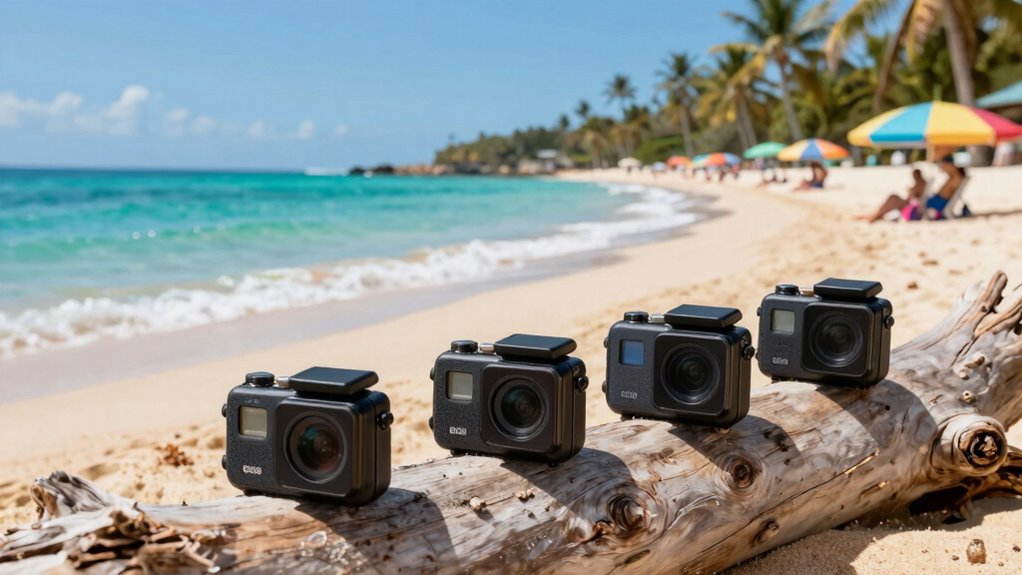

For a waterproof camera for beach travel, I would start with the Olympus Tough TG-6 for its more established rugged feature set and 4× optical zoom, or the KODAK PIXPRO WPZ2 bundle if a spare battery and floating strap matter more than 4K video. The 64MP dual-screen camera is a better match for family selfies and casual shallow-water use. Those strengths point to the main tradeoff: the newer compact options advertise higher megapixel counts and 4K, while the Olympus and Kodak offer optical zoom and a more conventional camera experience. None of these is a deep-diving camera, and beach use still calls for careful sealing, rinsing off salt, and checking each model’s limits before entering the water.

Get travel and outdoor gear delivered free with Prime
- Fast, free delivery on millions of items
- Prime Video, Amazon Music and more included
- Member-only deals all year
I rank these five by how useful their documented features are for a real beach day: water protection, handling around water, practical framing, and the chance of capturing photos or video without carrying extra gear. I also account for the drawbacks that can change a purchase decision, including shallow depth limits, digital zoom, modest battery life, and older video specifications. My picks are not interchangeable: one suits snorkeling, another group selfies, and another buyers who value optical zoom and rugged construction over headline resolution.
Complete the kit


Key Takeaways
- The Olympus Tough TG-6 is the most versatile traditional camera here, with 4× optical zoom, RAW capture, and rugged protection, but its listed sensor resolution is 12 MP rather than 64 MP.
- The KODAK PIXPRO WPZ2 bundle includes a spare battery and floating strap, which can help on long beach days, but it records Full HD rather than 4K.
- The 64MP dual-screen camera is the clearest family-selfie pick because it has front and rear screens; its stated underwater limit is about 16 feet and its battery is rated for up to 70 minutes.
- The two floatable 64MP compact cameras pair shallow-water use with included memory, but their 16× zoom is digital, not optical, so it cannot replace the Olympus or Kodak zoom lens.
- All five have limits: check the seal and depth rating before use, keep salt and sand away from the battery door, and do not treat any listed camera as a surf-proof or deep-diving system.
| Olympus Tough TG-6 Waterproof Compact Camera |  | Best Overall for Rugged Beach Photography | Sensor: 12 MP BSI CMOS, 1/2.3-inch | Lens: 4× optical zoom, 25–100 mm equivalent | Video: 4K at 30 fps; Full HD up to 120 fps | VIEW ON AMAZON | See Our Full Breakdown |
| KODAK PIXPRO WPZ2 Waterproof Digital Camera Bundle |  | Best Bundle for Longer Beach Days | Sensor: 16.35 MP, 1/2.3-inch BSI CMOS | Lens: 4× optical zoom | Video: Full HD 1920 × 1080 at 29.97 fps | VIEW ON AMAZON | See Our Full Breakdown |
| 4K Underwater Camera, 16FT Waterproof Camera, 64MP Dual-Screen |  | Best for Family Selfies and Easy Snorkeling | Photo resolution: 64 MP stated | Video: 4K advertised; listed resolution 2160p | Water depth: About 16 feet; IP68 stated | VIEW ON AMAZON | See Our Full Breakdown |
| 4K Underwater Camera, 64MP 16FT Compact Waterproof Camera with 16GB Card |  | Best Floatable Value for Shallow Water | Photo resolution: 64 MP stated | Video: 4K advertised; information table lists 1080p at 30 fps | Water protection: IP68 stated; up to 16 feet | VIEW ON AMAZON | See Our Full Breakdown |
| 64MP 4K Floatable Waterproof Camera with Autofocus, 16X Zoom, and 16GB Card |  | Best Beginner Pick for Simple Water Play | Photo resolution: 64 MP stated | Video: 4K at 30 fps stated | Water depth: 16 feet; IP68 stated | VIEW ON AMAZON | See Our Full Breakdown |
| waterproof camera for beach travel | Video | Display | Sensor | Photo resolution |
|---|---|---|---|---|
| Olympus Tough TG-6 Waterproof | 4K at 30 fps; Full HD up to 120 fps | 3-inch LCD, 1,040,000 dots | 12 MP BSI CMOS, 1/2.3-inch | — |
| KODAK PIXPRO WPZ2 Waterproof D | Full HD 1920 × 1080 at 29.97 fps | 2.7-inch LCD, 230,000 dots | 16.35 MP, 1/2.3-inch BSI CMOS | — |
| 4K Underwater Camera | 4K advertised; listed resolution 2160p | — | 1/3.2-inch CMOS | 64 MP stated |
| 4K Underwater Camera | 4K advertised; information table lists 1080p at 30 fps | 2.7-inch IPS LCD | — | 64 MP stated |
| 64MP 4K Floatable Waterproof C | 4K at 30 fps stated | 2.7-inch IPS LCD | — | 64 MP stated |
More Details on Our Top Picks
Olympus Tough TG-6 Waterproof Compact Camera
The Olympus Tough TG-6 takes the top spot because it offers the most balanced conventional-camera toolkit in this group. Its 4× optical zoom is the standout beach advantage: I can frame a shoreline detail, boat, or family member farther down the sand without depending on the digital enlargement used by the two floatable 64MP compacts. It also records 4K video, supports RAW files, and has a bright f/2 maximum aperture, giving it more flexibility than a simple point-and-shoot when light changes near sunset or under a shaded umbrella.
Its rugged construction is described as resistant to water, drops, crushing, dust, and moisture, and its GPS and environmental sensors can add useful trip context. Compared with the Kodak WPZ2, the TG-6 offers 4K and RAW; compared with the dual-screen 64MP camera, it gives up easy front-screen selfies and a floating body. The supplied details do not state a specific waterproof depth, so I would verify the manufacturer’s current limit before snorkeling rather than infer one from the Tough name.
The main compromise is resolution: the 12MP sensor is far below the 64MP claims on the newer compact cameras, and the sensor itself is small. That does not automatically make the Olympus worse for everyday prints, but buyers who want heavy cropping or prioritize a high number on the spec sheet may prefer another pick. Its fixed rear display also makes self-framing less convenient. I rank it first for its useful optical zoom and broad rugged feature set, not for the biggest resolution claim.
Pros:- 4× optical zoom frames distant beach subjects without digital enlargement.
- Records 4K video and high-speed Full HD footage.
- Supports RAW as well as JPEG image files.
- Rugged construction and built-in GPS, compass, and other environmental sensors.
Cons:- 12MP resolution and a small sensor may disappoint buyers focused on high-resolution cropping.
- The display is fixed, making selfies harder to compose than with a dual-screen camera.
- The supplied product details do not specify its waterproof depth.
Best for: Beach travelers who want optical zoom, RAW capture, 4K video, and a rugged camera for mixed shoreline and outdoor use.
Not ideal for: Buyers who need a front-facing selfie screen, a floating body, a stated depth limit before purchase, or the highest advertised photo resolution.
- Sensor:12 MP BSI CMOS, 1/2.3-inch
- Lens:4× optical zoom, 25–100 mm equivalent
- Video:4K at 30 fps; Full HD up to 120 fps
- Aperture:Maximum f/2
- Image formats:JPEG and RAW
- Display:3-inch LCD, 1,040,000 dots
- Connectivity and sensors:Wi-Fi, GPS, manometer, compass, thermometer
Our verdict“I would choose the TG-6 for the broadest beach-ready camera toolkit, provided its depth rating fits the planned water use.”
KODAK PIXPRO WPZ2 Waterproof Digital Camera Bundle
The KODAK PIXPRO WPZ2 bundle is the practical pick when staying ready matters more than recording 4K. The included spare battery and floating strap address two common beach annoyances: running out of power during a full day out and losing track of a camera after a drop near the water. The included memory card and reader add useful travel accessories, though a spare battery is the bundle’s most meaningful advantage for a day spent away from an outlet.
Its 4× optical zoom gives it a framing advantage over the 16× digital zoom on the floatable compact cameras, and the 16.35MP BSI CMOS sensor is a more modest, clearly stated resolution than their 64MP claims. It also has Wi-Fi and digital image stabilization. Compared with the Olympus TG-6, however, the WPZ2 records Full HD rather than 4K and does not list RAW support. Its listed rugged protection covers water, dust, and shock, but the supplied description does not give a depth figure, so I would check the exact manufacturer rating before planning underwater use.
The 2.7-inch screen has a relatively low stated dot count, and there is no built-in flash. Its video format is a more basic choice than the 4K offerings, so this is not my recommendation for travelers who want high-resolution clips or extensive editing flexibility. I put it above the shallow-water 64MP models for buyers who value optical zoom and ready-to-go accessories, but below the TG-6 because the Olympus has a stronger video and still-image feature set.
Pros:- 4× optical zoom is more useful for distant framing than digital zoom.
- Bundle includes a spare battery, floating strap, memory card, and card reader.
- Water-, dust-, and shock-resistant design is suited to active travel.
- Wi-Fi and digital image stabilization support sharing and steadier-looking shots.
Cons:- Video tops out at Full HD in the supplied specifications.
- The 2.7-inch display has a listed resolution of 230,000 dots.
- No built-in flash is listed, and no specific waterproof depth is provided.
Best for: Travelers who want a conventional waterproof compact with optical zoom, a spare battery, memory, and a floating strap in the box.
Not ideal for: Buyers who want 4K video, RAW image files, a high-resolution display, or a clearly stated underwater depth from the supplied details.
- Sensor:16.35 MP, 1/2.3-inch BSI CMOS
- Lens:4× optical zoom
- Video:Full HD 1920 × 1080 at 29.97 fps
- Display:2.7-inch LCD, 230,000 dots
- Connectivity:Built-in Wi-Fi
- Image stabilization:Digital
- Bundle items:32GB microSD card, spare battery, card reader, floating strap
Our verdict“I recommend the WPZ2 bundle to beach travelers who value optical zoom and extra power more than 4K footage.”
4K Underwater Camera, 16FT Waterproof Camera, 64MP Dual-Screen
This dual-screen 64MP compact stands out for family beach trips because its front screen makes group selfies and short clips easier to frame. That is a more useful distinction than its resolution claim for travelers who mainly want everyone in the shot without asking another person to take the photo. The camera is described as floatable, autofocus is operated with a half-press of the shutter, and an included 16GB card means it can be used without immediately adding storage.
Against the TG-6 and WPZ2, it gives up optical zoom and RAW support, but it offers a more approachable selfie setup and a stated depth close to 16 feet. The listed battery is rated for up to 70 minutes, which may be enough for casual swimming or several short snorkeling sessions but is not generous for a long day of continuous filming. Autofocus instructions are clearly described, a useful touch for first-time camera users who may not want to manage manual settings while keeping the device dry and secure.
I would choose this over the other floatable compact, the B0H9YZXK1Z, when front-and-rear screens and a larger stated 1,250mAh battery are priorities. Its drawbacks are still meaningful: the product information lists a 1/3.2-inch sensor, no optical zoom, and a depth limit around 16 feet. The title and description advertise 4K, while the listed video resolution says 2160p; the supplied details are not fully consistent, so I would confirm the actual recording mode before buying for video-heavy travel.
Pros:- Front and rear screens make self-portraits and group framing easier.
- Floatable body and a stated waterproof depth of about 16 feet suit shallow-water outings.
- Autofocus controls are described in simple half-press steps.
- Includes a 16GB card and supports microSD cards up to 128GB.
Cons:- No optical zoom is listed, so it is less suited to distant beach subjects.
- Battery is rated for up to 70 minutes of operation.
- Supplied video specifications are inconsistent, and the listed sensor is small.
Best for: Families and casual snorkelers who want a front screen for selfies, simple autofocus, and a floatable camera for shallow-water use.
Not ideal for: Travelers who need optical zoom, longer recording sessions, deep-water capability, or fully consistent published video specifications.
- Photo resolution:64 MP stated
- Video:4K advertised; listed resolution 2160p
- Water depth:About 16 feet; IP68 stated
- Sensor:1/3.2-inch CMOS
- Displays:Front and rear screens; 2.7-inch listed display
- Battery:1,250mAh; up to 70 minutes stated
- Storage:16GB card included; supports up to 128GB microSD
Our verdict“I would pick this for family selfies and uncomplicated shallow-water use, after confirming the video mode that matters to me.”
4K Underwater Camera, 64MP 16FT Compact Waterproof Camera with 16GB Card
This compact is a straightforward fit for beachgoers who want a floatable body, autofocus, and included memory without stepping up to the more feature-rich Olympus. The stated IP68 design is rated for use to 16 feet, and the camera is described as returning to the surface if dropped in water. That can make it easier to spot than a sinking compact, although I would still use a wrist strap when swimming or snorkeling.
Its listed feature set includes a 2.7-inch IPS screen, fill light, self-timer, burst shooting, and face and smile detection. Those extras may help with casual snapshots, but they do not make it a substitute for a camera with optical zoom. The 16× zoom is digital, so the Olympus TG-6 and Kodak WPZ2 are better choices for framing distant subjects while preserving detail. Compared with the other floatable 64MP option, it claims more expandable storage—up to 256GB—but uses a smaller 650mAh battery and does not offer the dual-screen selfie advantage.
There is a specification conflict worth checking: the title and description advertise 4K, while the product information table lists 1080p video. The stated battery life is more than 70 minutes of continuous recording, which is still a short-session proposition beside the WPZ2 bundle’s spare battery. I rank it as a modest shallow-water choice, not a camera for buyers who need dependable, clearly documented 4K, long filming sessions, or genuine optical reach.
Pros:- Floatable design and stated IP68 protection to 16 feet suit shallow-water activities.
- Includes a 16GB card and supports storage expansion up to 256GB.
- Autofocus, fill light, burst, timer, and face-detection modes are listed.
- Compact size is practical for carrying between beach and pool.
Cons:- 16× zoom is digital rather than optical.
- The 650mAh battery is rated for just over 70 minutes of continuous recording.
- 4K marketing claims conflict with the information table listing 1080p.
Best for: Casual beach users who want a floating compact with autofocus, basic shooting modes, and room to expand storage.
Not ideal for: Buyers who need optical zoom, a second selfie screen, a large battery, or unambiguous 4K documentation.
- Photo resolution:64 MP stated
- Video:4K advertised; information table lists 1080p at 30 fps
- Water protection:IP68 stated; up to 16 feet
- Display:2.7-inch IPS LCD
- Zoom:16× digital
- Battery:650mAh; more than 70 minutes continuous recording stated
- Storage:16GB card included; supports up to 256GB
Our verdict“I would choose this for casual shallow-water snapshots, but not when zoom quality or verified 4K is a priority.”
64MP 4K Floatable Waterproof Camera with Autofocus, 16X Zoom, and 16GB Card
The pink 64MP floatable camera is the easiest fit for a beginner who wants basic controls and a camera that will not immediately disappear below the surface if dropped. It is rated for use to 16 feet, includes a 16GB card, and has autofocus, a self-timer, burst shooting, and face and smile detection. Those modes give families a few simple ways to capture pool time or a beach outing without needing to learn a more involved camera system.
Its 2.7-inch screen is straightforward, and the floating body is a practical safeguard for shallow-water use. The 16× digital zoom sounds expansive but is not equivalent to the 4× optical zoom on the TG-6 and WPZ2; I would use it for loose framing rather than expect detailed close-ups of distant boats or wildlife. Compared with the B0HFRH5NNT, this camera lists a 650mAh battery as well, but it offers less maximum storage expansion—256GB on the other model versus 256GB here is actually the same stated ceiling—so the more meaningful difference is the competing model’s fill light and described IPS display.
The stated battery supports over 70 minutes of continuous recording, so I would not plan to film a full day without breaks or a charging plan. Its 4K and 64MP claims also do not tell the whole image-quality story, particularly without a stated sensor size in the supplied specifications. I place it fifth because the other floatable compacts add a larger battery claim or more clearly listed practical extras, while the Olympus and Kodak give better optical framing for general travel photography.
Pros:- Floatable body and stated 16-foot water depth suit casual water play.
- Autofocus and simple timer and detection modes are beginner-friendly.
- Includes a 16GB card and supports expansion up to 256GB.
- Compact form is easy to pack for a family beach trip.
Cons:- 16× zoom is digital and cannot match optical zoom for distant subjects.
- 650mAh battery is rated for over 70 minutes of continuous recording.
- Supplied specifications do not state sensor size or clearly detail all video modes.
Best for: Beginners and families who want a simple floating camera for swimming, pool play, and casual shallow-water photos.
Not ideal for: Travelers who need optical zoom, long continuous video, a high-confidence sensor comparison, or features for more deliberate photography.
- Photo resolution:64 MP stated
- Video:4K at 30 fps stated
- Water depth:16 feet; IP68 stated
- Display:2.7-inch IPS LCD
- Zoom:16× digital
- Battery:650mAh removable; over 70 minutes recording stated
- Storage:16GB card included; supports up to 256GB
Our verdict“I would choose it as a simple floating camera for family water play, not as the strongest all-around travel camera.”

How We Picked
I compared these options for beach travel specifically, rather than ranking them by the largest resolution number or the longest list of modes. My first question was whether the stated water protection suits swimming, pool use, or shallow snorkeling, and whether the product details give a clear depth limit. A rating or depth figure is useful only when the compartment is correctly closed and the camera is used within its stated limits; I do not treat it as permission to take risks in surf or deeper water.
Next, I weighed what affects day-to-day beach photography: optical versus digital zoom, screen layout, buoyancy, battery life, storage, and video format. Optical zoom changes framing without relying on a crop, while digital zoom can make distant subjects look less detailed. A floating body or strap can make recovery easier after a drop, but neither substitutes for a secure hand grip. A front screen can help a family compose a selfie, whereas a conventional rear display and optical zoom are more useful for framing scenes beyond arm’s reach.
I also separated documented specifications from marketing claims. For example, 64MP is a stated output resolution, not proof that a small sensor will produce better beach photos than a lower-resolution camera. Some supplied details conflict: one camera is described as recording 4K in its title and product copy while its information table lists 1080p; I call out that mismatch rather than assuming the higher specification is guaranteed. My ranking favors the clearest practical fit, with honest penalties for shallow depth limits, small batteries, digital zoom, and less current video options.
Factors to Consider When Choosing Waterproof Camera For Beach Travel
For beach travel, I would match the camera to the water activity and the kind of shots I actually expect to take. These picks split into two groups: rugged compacts with optical zoom and shallow-water cameras with floatable bodies, selfie features, or high-resolution claims.Start with the depth limit, not the marketing label
A camera described as waterproof is not automatically suitable for every underwater outing. The two floatable compact cameras and the dual-screen model state a limit around 16 feet, which is aimed at shallow swimming or snorkeling rather than deep diving. The supplied descriptions for the Olympus TG-6 and Kodak WPZ2 do not include a specific depth figure, so I would check the current manufacturer documentation before taking either underwater. Water ratings also depend on a correctly closed compartment and intact seals; salt, sand, a trapped hair, or a poorly seated door can undermine protection.
For surf, I would be more cautious than the word waterproof suggests. Waves can involve impact and pressure beyond a calm pool, and no camera here should be treated as indestructible. I would inspect the door and seal, keep the camera within its stated limits, and rinse salt residue off according to the maker’s instructions after use.
Choose optical zoom when framing distant subjects
The TG-6 and WPZ2 list 4× optical zoom, while the compact floatable models list 16× digital zoom. Optical zoom changes the lens framing; digital zoom enlarges or crops the image, which can make detail look softer. For kids playing farther down the beach, boats, or wildlife, the Olympus and Kodak are the stronger choices on the information provided. For arm’s-length selfies, underwater snapshots, and nearby family scenes, the digital zoom may matter less.
Do not confuse a large megapixel number with a guaranteed better image. The 64MP claims are attractive on paper, but sensor size, lens quality, exposure, and processing also shape the result. The TG-6’s 12MP count is lower, yet its optical zoom, RAW support, and aperture information provide a different kind of flexibility. I would decide based on how I frame and edit pictures, not the resolution figure alone.
Match screen layout to your subjects
A front-facing screen is most useful when I want to include myself and a group in a beach photo. The dual-screen camera is the clear pick for that job. A single rear screen, as on the Olympus and Kodak, is less convenient for self-framing but may suit travelers taking landscapes and candid photos. The floatable compacts list rear displays, so they are better for pointing at nearby activity than checking a self-portrait composition.
Bright sun can make any screen harder to see. The supplied descriptions do not provide comparable outdoor-brightness measurements, so I would not assume one screen is sun-proof just because it is described as IPS or high definition. A shaded hand, careful angle, and a few test shots can matter more than a panel label at the beach.
Plan around battery and storage
The two small floatable cameras list 650mAh batteries and roughly 70 minutes or more of continuous recording, while the dual-screen option lists a 1,250mAh battery and up to 70 minutes of operation. These figures are not directly comparable because camera settings and use affect runtime, but none suggests carefree all-day filming. The WPZ2 bundle’s spare battery is a practical advantage for a long excursion; the other models may call for charging breaks or carrying a backup power plan.
Included cards differ too. The compact cameras arrive with 16GB cards, and the Kodak bundle lists a 32GB card. The dual-screen camera supports cards up to 128GB, while the B0HFRH5NNT and B0H9YZXK1Z list expansion up to 256GB. Video fills storage faster than occasional stills, so I would bring a compatible spare card for a trip with lots of clips and confirm the camera’s card requirements before leaving home.
Treat contradictory specifications as a buying question
Two product descriptions advertise 4K video while their product information tables list 1080p. The dual-screen camera’s details also use both 4K and 2160p wording. I would not silently assume that the most ambitious claim is the verified operating mode. If 4K recording is a deciding feature, I would confirm the exact resolution and frame rate from the manufacturer or seller before purchasing.
That same care applies to water depth, battery claims, and megapixel figures. A clear specification is more useful than an expansive headline, especially when a mistake could leave a camera out of its intended use. Rank the qualities that matter most—safe shallow-water use, optical framing, selfie composition, or extra battery—and let ambiguous claims count against a model rather than assuming they will work as hoped.
Frequently Asked Questions
Which camera is the strongest all-around choice for beach travel?
I rank the Olympus Tough TG-6 first for its combination of 4× optical zoom, 4K video, RAW support, and rugged construction. It is a better fit than the floatable compacts for travelers who want to frame distant subjects without digital zoom. Its listed sensor resolution is only 12MP, it lacks a front screen, and the supplied details do not state a waterproof depth, so I would verify that limit before snorkeling.
Are the 64MP cameras automatically better for beach photos?
No. A 64MP claim describes the stated photo resolution, but it does not by itself establish better image quality. Sensor size, lens, exposure, and image processing also matter. The Olympus lists 12MP but has optical zoom and RAW support, while the Kodak has a 16.35MP sensor and optical zoom. I would choose based on the way I plan to frame and use photos rather than compare megapixel counts alone.
Can I take these cameras snorkeling?
The dual-screen model and two floatable compacts state underwater use to about 16 feet, making them the clearest matches for shallow snorkeling on the supplied information. I would still read the exact instructions and check the battery door seal before entering the water. The TG-6 and WPZ2 descriptions provided here do not give a depth figure, so I would confirm their manufacturer ratings before using them underwater. None should be assumed suitable for deep diving.
Is a floating camera enough protection against losing it?
No. A floating body can make a dropped camera easier to see and retrieve, but it can drift, be pushed by waves, or get carried away by a current. The WPZ2 bundle includes a floating strap, while two compact models are described as floatable. I would still attach a secure wrist strap and keep hold of the camera in surf or crowded water, especially when conditions make recovery difficult.
Which option is best for family selfies and group shots?
The 64MP dual-screen camera is the most direct match because it has front and rear screens, making it easier to see the group while composing a self-portrait. That convenience is a stronger reason to choose it than its high resolution claim. The Olympus and Kodak offer optical zoom but no front-facing screen in the supplied details, so they make more sense for conventional photos than repeated self-framing.
Conclusion
For a traveler who wants the most flexible traditional camera, I would choose the Olympus Tough TG-6, then confirm its water-depth limit before any snorkeling. For someone who values optical zoom and backup power, the KODAK PIXPRO WPZ2 bundle is the more practical beach-day kit, with Full HD video as the tradeoff. Families who prioritize easy group selfies should look at the dual-screen compact, while casual swimmers wanting a floatable body can compare the two 16-foot models and pay close attention to their battery and video-specification caveats.
I would skip any of these if the trip calls for deep-water diving, extended continuous filming, or guaranteed protection from heavy surf. Whichever one I choose, I would keep to the stated depth, secure the camera with a strap, check the compartment seal before every water session, and rinse away salt and sand after the day. Those habits matter as much as choosing between a 12MP optical-zoom camera and a 64MP floatable compact.