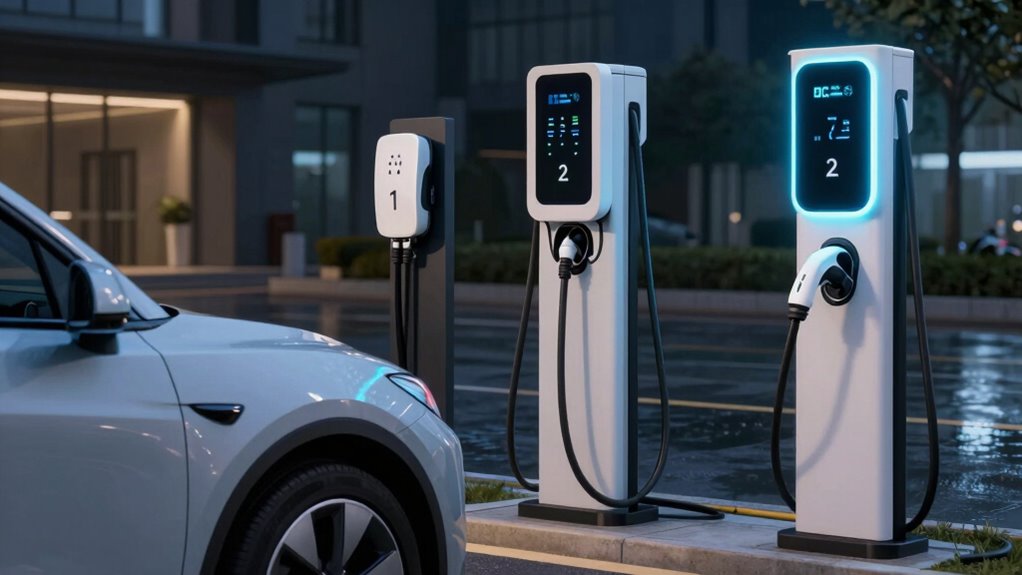

Understanding EV charging levels helps you choose the best option for your needs. Level 1 uses a standard 120-volt outlet, offering slow charging ideal for overnight use. Level 2 requires a 240-volt outlet and charges faster, suitable for daily use at home or public stations. DC Fast Charging provides quick top-ups in about 30 minutes, perfect for long trips. To find out which type suits your driving habits and vehicle, keep exploring the details ahead.

Get travel and outdoor gear delivered free with Prime
- Fast, free delivery on millions of items
- Prime Video, Amazon Music and more included
- Member-only deals all year
Key Takeaways
- Level 1 uses standard 120V outlets, providing slow charging of 4-5 miles per hour.
- Level 2 requires a 240V outlet, offering faster charging around 25-30 miles per hour.
- DC Fast Charging delivers high-voltage direct current, adding about 80% range in 20-30 minutes.
- Compatibility varies; most EVs support Level 1 and 2, but DC Fast Charging may need adapters or specific vehicle support.
- Choose based on driving habits, with Level 1 for minimal needs, Level 2 for everyday use, and DC Fast for quick top-ups during trips.
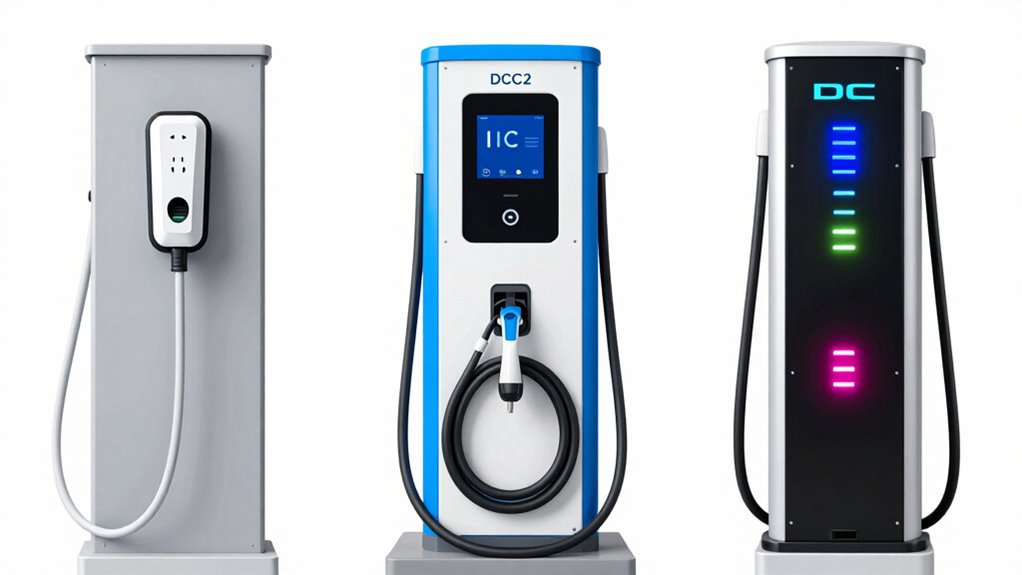
Electric vehicle charging comes in different levels, each designed to suit various needs and situations. When choosing a charging station, it’s crucial to understand how each level interacts with your vehicle’s charging capabilities and the overall energy efficiency comparison. Level 1 charging is the simplest form, using a standard household outlet. It typically provides about 4 to 5 miles of range per hour of charging, making it ideal for overnight charging or situations where you have plenty of time. Because it uses standard 120-volt outlets, charging station compatibility isn’t usually an issue for most vehicles, but keep in mind that this slow pace isn’t suitable for daily quick top-ups if you’re on a tight schedule. Still, it’s the most accessible option and often the most cost-effective since it requires no special equipment beyond an extension cord or a basic charging unit.
Moving up, Level 2 charging requires a dedicated 240-volt outlet, similar to what’s used for large appliances like dryers. This setup considerably speeds up charging times, offering roughly 25 to 30 miles of range per hour. It’s a popular choice for home installations and public charging stations alike, thanks to its balance between convenience and installation cost. When considering charging station compatibility, most EVs are compatible with Level 2 chargers, but it’s always wise to verify your vehicle’s specifications. Energy efficiency comparison shows that Level 2 chargers generally deliver more energy per minute of charging compared to Level 1, meaning you get more miles for your energy input, making it a smarter choice for regular use. Plus, many Level 2 chargers come with smart features, allowing you to monitor energy consumption and optimize charging times, which can further enhance overall efficiency. Additionally, the advancements in European cloud solutions are helping to optimize smart charging systems for better energy management.
Finally, DC Fast Charging represents the highest level of charging technology. It bypasses the vehicle’s onboard charger and delivers high-voltage direct current directly to the battery. This results in rapid charging, often providing 80% of a vehicle’s range in just 20 to 30 minutes. This level is perfect for long trips or quick stops, but not every vehicle is compatible due to charging station compatibility limitations—most EVs need specific adapters or built-in support for fast-charging. In terms of energy efficiency comparison, DC fast chargers are less efficient in terms of energy transfer compared to Level 2, due to heat loss and the high power demand. However, their speed makes them invaluable for road trips and emergency top-ups. Each level serves different needs, so understanding your vehicle’s specifications and your typical driving habits can help you choose the best option, balancing convenience, cost, and energy efficiency.
Frequently Asked Questions
How Do Charging Levels Affect EV Battery Lifespan?
Charging levels considerably impact your EV battery lifespan by influencing battery degradation and charging cycles. Level 1 charging, being slow, reduces stress on the battery, extending its life. Level 2 offers faster charging but still maintains a gentle cycle, while DC Fast charging accelerates battery degradation due to rapid charge cycles. To prolong your battery’s health, avoid frequent fast charging and keep your charging levels balanced, minimizing wear over time.
Can I Upgrade My Home Charger to a Higher Level?
You can definitely upgrade your home charger; nearly 60% of EV owners have done so for faster charging. A charger upgrade involves a home installation, which may require an electrical inspection and possibly upgrading your circuit breaker. Check with a licensed electrician to confirm your current setup supports a higher-level charger. Upgrading provides shorter charging times, making it more convenient to keep your EV ready for any trip.
Are There Safety Concerns With High-Voltage DC Fast Chargers?
Yes, there are safety concerns with high-voltage DC fast chargers, mainly related to high voltage hazards. You should follow strict safety protocols when handling or working near these chargers to prevent electric shock or injury. Manufacturers design these chargers with safety features like automatic shut-offs and protective enclosures, but it is crucial to be cautious, stay trained, and adhere to all safety guidelines to minimize risks associated with high-voltage equipment.
How Do Charging Speeds Vary With Different EV Models?
Charging speeds for your EV are like a racecar on different tracks—some models zoom faster than others. You might notice varying times due to battery size, design, and charging station compatibility. Keep in mind, frequent fast charging can accelerate battery degradation over time. To maintain peak performance, match your EV model with compatible chargers and avoid excessive quick charges, ensuring your car stays speedy and healthy for miles ahead.
What Are the Costs Associated With Installing Each Charging Level?
You’ll find installation costs vary by charging level: Level 1 is cheapest, often included with the vehicle, with minimal setup needed. Level 2 costs more upfront due to wiring and equipment but offers faster charging. DC Fast chargers are the most expensive to install because of advanced technology and infrastructure. Maintenance expenses are generally low but depend on usage; regular inspections help guarantee reliability and safety over time.
Conclusion
Think of EV charging levels like filling a cup—Level 1 is a gentle stream, perfect for overnight refills, while Level 2 is a steady pour, ideal for quick top-ups. DC fast chargers are like a rush of water, filling your cup in minutes. When I visited a charging station, watching cars queue for fast chargers made me realize how essential choosing the right level is—like picking the best faucet for your needs, it makes all the difference.
Columbus Day / Indigenous Peoples' Day Picks
long weekend sales
As an affiliate, we earn on qualifying purchases.